





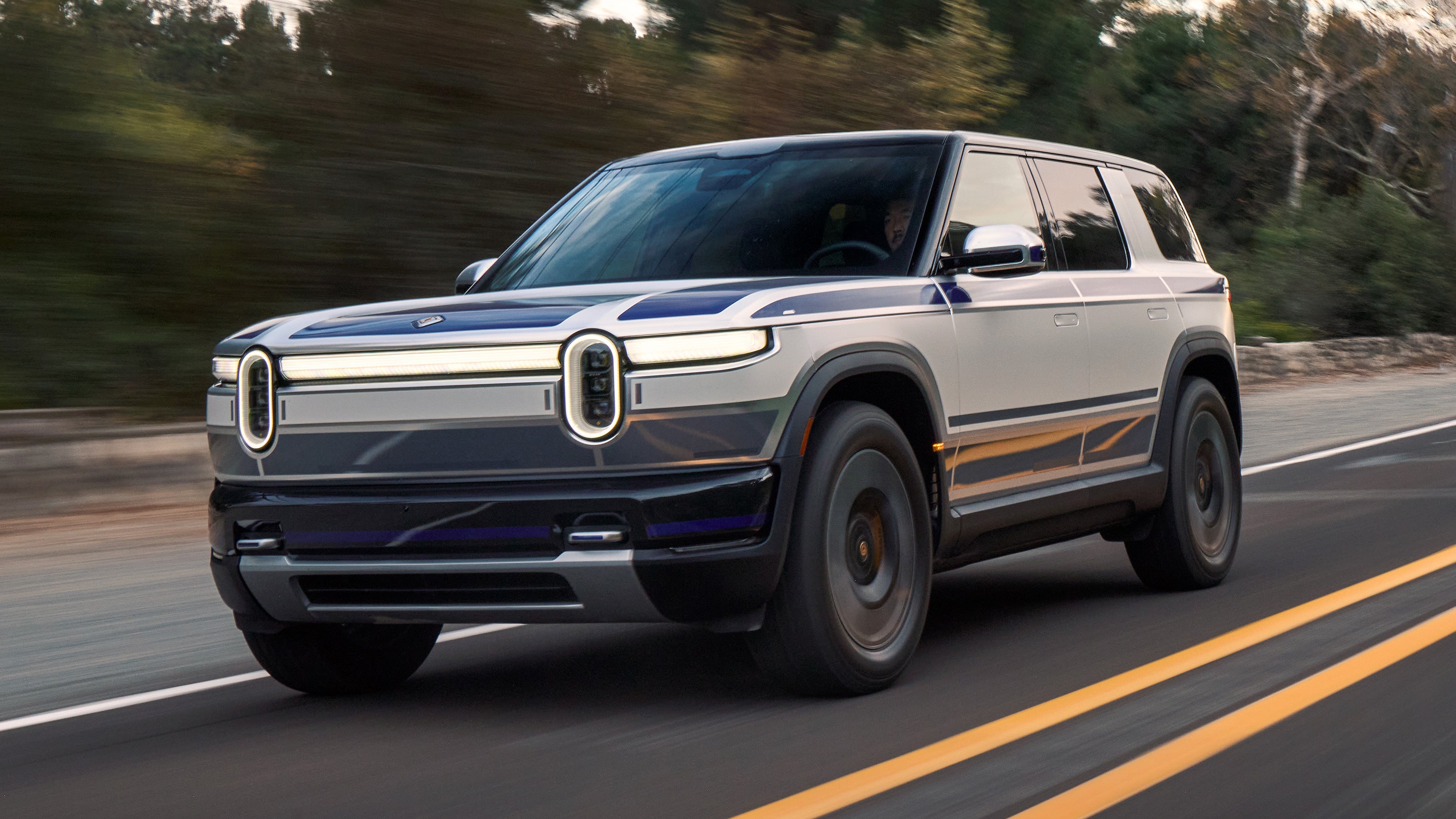
Why the R2 Matters More Than Any Rivian Before It
Rivian’s current lineup has earned praise for blending long driving range, strong performance and genuine off-road capability. The R1S in particular delivers impressive acceleration and continuous software improvements through over-the-air updates. The challenge, however, has always been cost. A dual-motor R1S with solid equipment can approach $85,000, while higher trims exceed $100,000. That pricing limits volume growth.
The upcoming R2 is intended to change that equation. Rivian has repeatedly pointed to a target entry price of about $45,000, positioning the vehicle far below its flagship SUV. After driving a near-production prototype, it is clear the company is not merely shrinking its existing formula. Instead, the R2 represents a broader reset aimed at expanding Rivian’s audience.

Prototype Specifications at a Glance
Below are the preliminary details provided for the dual-motor prototype tested:
| Specification | 2026 Rivian R2 (Prototype) |
|---|---|
| Estimated Base Price | $45,000 (target) |
| As-Tested Price | Not yet announced |
| Battery Capacity | 87.4 kWh (preliminary) |
| Estimated Range | 300+ miles |
| Charging Time | 10%–80% in ~30 minutes |
| Output | 656 hp / 609 lb-ft |
| Drivetrain | Dual-Motor All-Wheel Drive |
| Charging Port | NACS (Tesla-style) |
| Electrical System | 400-volt architecture |
Final EPA figures and official pricing remain pending.
Smaller Footprint, Familiar Identity
Visually, the R2 clearly belongs to the Rivian family. Its upright stance and squared proportions echo the larger R1S. Yet the new model is meaningfully more compact. It measures roughly 15 inches shorter in length, four inches narrower, and nearly 11 inches lower in height compared to the R1S.
In person, its dimensions align closely with high-volume crossovers like the Tesla Model Y. The reduction in size addresses one frequent criticism of the R1S: maneuverability. The larger SUV can feel cumbersome in dense urban environments. The R2, by contrast, strikes a balance between interior space and everyday usability.
Despite the smaller exterior, the cabin does not feel cramped. The tall roofline and relatively low beltline preserve outward visibility and passenger comfort. Rivian’s design team deliberately avoided the sloping “aero blob” silhouette common among modern electric crossovers, favoring a shape that communicates durability.

Performance That Exceeds Expectations
With 656 horsepower and 609 lb-ft of torque, the dual-motor R2 delivers acceleration comparable to high-performance trims of the R1S. Rivian estimates a 0–60 mph time of 3.6 seconds, placing it firmly in sports-car territory.
On public roads, the prototype’s passing power felt immediate and forceful. The vehicle’s lighter mass—thanks to a newly engineered platform—contributes to its responsiveness. While it may not match the razor-sharp dynamics of dedicated performance EVs such as the Hyundai Ioniq 5 N, the R2 blends straight-line speed with composed handling.
Rivian has confirmed that the R2 rides on an entirely new architecture. This structure uses roughly half the number of materials and components found in earlier models. Wiring has also been significantly reduced compared to first-generation vehicles. Beyond lowering production costs, these efficiencies help reduce weight and improve overall packaging.
Charging and Battery Strategy
The prototype carried an 87.4 kWh battery pack, though final capacities may vary by trim. Rivian projects a range exceeding 300 miles for the dual-motor configuration.
Charging performance is expected to allow replenishment from 10% to 80% in approximately 30 minutes under optimal conditions. The vehicle uses a 400-volt electrical system, rather than the 800-volt setups seen in some high-end EVs. While maximum charging speeds have not been disclosed, the inclusion of the North American Charging Standard (NACS) port ensures compatibility with Tesla’s Supercharger network.
In a market where federal tax incentives have become less predictable, Rivian’s leadership appears to be betting that competitive performance and practical range—not subsidies—will drive demand.

Off-Road Capability Without Air Suspension
Unlike the R1S, the R2 does not include an adaptive air suspension system. That omission reflects cost considerations. Nevertheless, the prototype demonstrated stable body control on pavement and credible performance on light trails.
During a brief off-road session, the R2 handled dusty inclines and moderate descents with confidence. Multiple drive modes—such as All-Terrain, Rock Crawl and Sport—adjust throttle mapping and traction responses. Regenerative braking provided controlled downhill progress even without a dedicated hill descent program.
While few owners may exploit its full capability, the R2 maintains Rivian’s identity as a brand that prioritizes versatility.
A New Approach to Interior Controls
The R2 introduces a revised steering wheel interface featuring programmable haptic rollers. These multifunction controls replace traditional clusters of buttons. Drivers can adjust media, climate settings and vehicle modes through directional movements combined with tactile feedback.
Rivian’s software chief has emphasized that digital flexibility is central to this decision. Unlike fixed-function buttons, software-driven interfaces can evolve as new features are introduced through updates.
The system requires an adjustment period. Certain gestures felt intuitive, while others demanded more attention. With refinement and user familiarity, the interface could become a distinguishing feature rather than a novelty.

Market Position and Outlook
The R2 arrives at a pivotal moment for the American EV sector. Several competitors have slowed expansion plans, and consumer enthusiasm has moderated compared to the early growth phase of the segment. Rivian’s success increasingly depends on delivering a product that stands on its own merits.
If the final pricing remains close to $45,000, the R2 could appeal to buyers who previously viewed Rivian as unattainable. In regions such as California, where EV adoption already represents a substantial share of new vehicle sales, the R2 may resonate strongly.
After time behind the wheel, the prototype left a distinct impression. It combines speed, practicality and personality in a way that feels deliberate rather than derivative. Whether it can translate early promise into large-scale commercial success will depend on execution, reliability and final pricing. But as a product concept, the R2 suggests Rivian is prepared to compete beyond the premium niche it once occupied.
Recommend Reading: Rivian R2 Launches Without Lidar; Hardware Upgrade Plans Announced


Share:
Ferrari’s First Electric Supercar Reveals a Radical Interior Direction
Best EV Lease Deals and Financing Offers in February 2026