





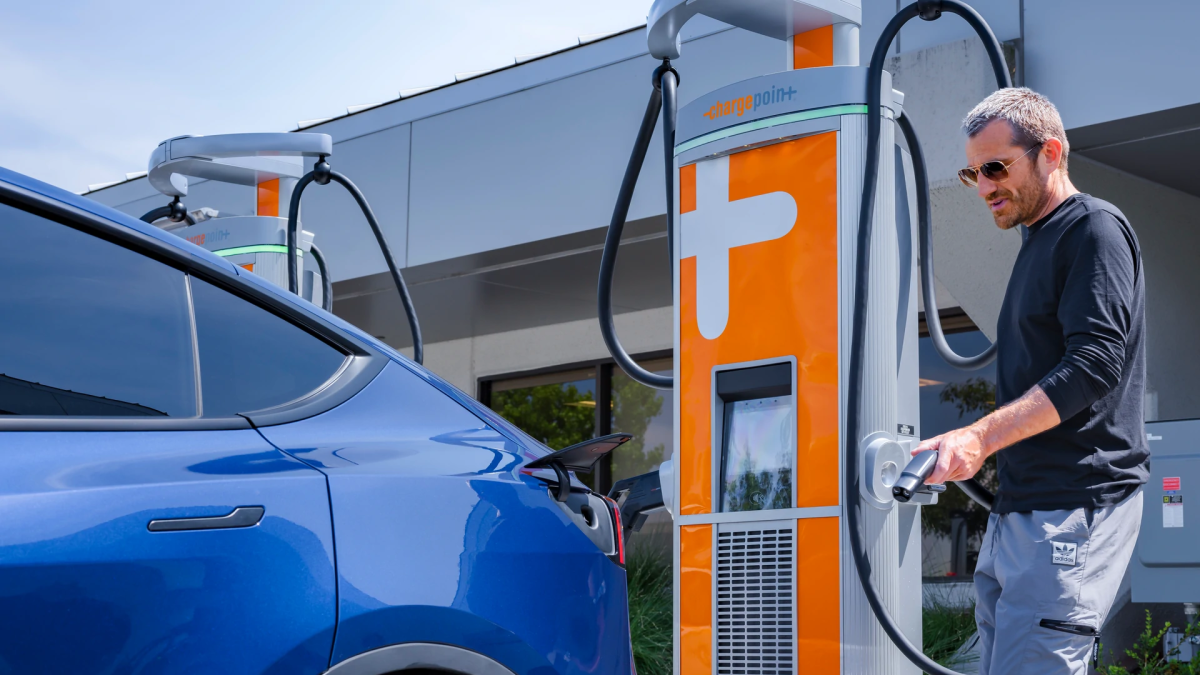
Despite widespread skepticism about the pace of electric vehicle adoption in the United States, one critical pillar of the transition quietly regained strength in 2025: federally funded public fast charging. After years of delays, lawsuits, and political uncertainty, the National Electric Vehicle Infrastructure (NEVI) program finally delivered measurable progress.

A Record Year for U.S. Fast-Charging Growth
The U.S. public fast-charging network expanded at a historic rate last year, growing by 30% and adding more than 18,000 new fast-charging ports nationwide. Most of that expansion was driven by private charging operators and automakers, but a notable portion came from NEVI-backed projects.
According to charging analytics firm Paren, nearly 100 NEVI-funded charging stations came online in 2025, adding close to 500 new fast-charging ports. While that number remains small relative to total installations, it represents a meaningful acceleration for a program that struggled to move beyond planning stages for much of its existence.
What NEVI Was Designed to Do
Created under the Bipartisan Infrastructure Law, NEVI is a $5 billion federal program aimed at building a reliable network of high-speed EV chargers along major U.S. travel corridors. Its purpose is not to replace private investment, but to fill geographic gaps, especially in rural areas and interstate routes where charging access has historically lagged.
By standardizing minimum power levels, uptime requirements, and site spacing, NEVI was intended to establish a baseline charging experience that EV drivers could depend on nationwide.
Political Turbulence and Legal Challenges
NEVI’s rollout was anything but smooth. In early 2025, the program became a political flashpoint when the Department of Transportation attempted to freeze funds and halt new contract awards. Several states sued, arguing that the move violated congressional authority and existing federal law.
Federal courts repeatedly sided with the states, ordering the funds to be released. A January ruling by a Seattle federal judge once again restored NEVI funding, reinforcing the program’s legal standing and limiting future administrative interference.
These legal victories proved critical in restoring confidence among states and charging providers alike.
Policy Adjustments Help Speed Deployment
Another factor behind NEVI’s improved performance was updated federal guidance released in October, which eased some of the program’s more rigid technical and procedural requirements. While standards around reliability and power output remained intact, the revisions gave states greater flexibility in site design and contracting.
As a result, states were able to move faster from planning to construction. Data from EVStates.org shows that 42 states now have approved NEVI deployment plans for 2026, with over $632 million already awarded to charging companies.
Why NEVI Matters Beyond Charger Counts
While NEVI-funded chargers represent only a fraction of total installations, their broader impact is strategic. As Paren CEO Florent Breton noted, NEVI sends a long-term signal to the market that public charging infrastructure remains a national priority.
That signal has attracted new players, including international hardware manufacturers and large-scale infrastructure developers, who might otherwise hesitate to enter the U.S. market. In many regions, NEVI sites also act as anchors that encourage nearby private investment.
A Fragile but Meaningful Recovery
NEVI’s comeback does not guarantee smooth sailing ahead. Further legal challenges remain possible, and regional disparities in charger deployment persist. Coastal states and major metro areas continue to outpace much of the Midwest and rural South in utilization and infrastructure density.
Still, after years of uncertainty, 2025 marked a turning point. NEVI moved from concept to execution, proving it can function even in a volatile political environment.

Looking Ahead
If current momentum holds, NEVI could scale much faster in the coming years, complementing private investment rather than competing with it. For EV drivers—especially those without home charging—this progress translates into greater reliability, better coverage, and fewer dead zones on long trips.
The program’s future is not guaranteed, but its recent rebound shows that federal EV infrastructure policy is far from finished.
Recommend Reading: Michigan Files Antitrust Lawsuit Accusing Oil Industry of Blocking EV Progress


Share:
Tesla Reports 1.1 Million FSD Subscribers as Autonomy Becomes a Core Business
Acura RSX Electric SUV: What to Expect From Acura’s Next-Generation EV