



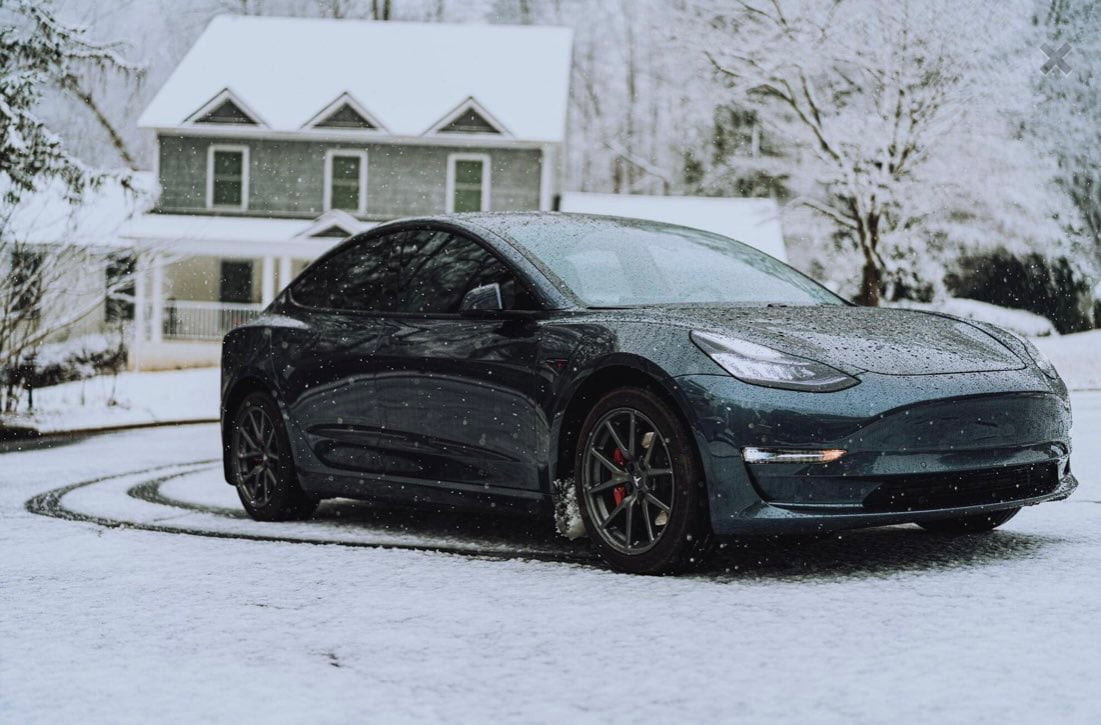
Testing an EV in Extreme Winter Conditions
With subzero temperatures persisting across parts of North America, a Canadian content creator decided to evaluate how an electric sedan performs in severe cold. The experiment focused on a 2024 Tesla Model 3 Long Range All-Wheel Drive, parked outdoors overnight in temperatures reaching -35°F (-37°C).
The goal was straightforward: measure how much battery capacity is consumed when the vehicle is stationary and relying solely on its heating system to maintain a survivable cabin environment. The test also examined post-experiment charging costs and whether extreme cold would affect basic vehicle functions.
The car was left outside for 12 consecutive hours, simulating a scenario in which occupants might be stranded during harsh winter weather.

Initial Conditions and Climate Settings
The test began at approximately 11 p.m. with the battery showing 80% state of charge. The vehicle was placed in Camping Mode, which allows the climate system to operate continuously while parked.
Interior temperature was set to 60°F (15.5°C). While not particularly warm, this setting is sufficient to prevent frostbite and hypothermia during prolonged exposure to freezing conditions. The objective was not comfort, but safety.
By establishing moderate heating rather than maximum output, the test aimed to reflect a realistic emergency scenario rather than a worst-case energy drain.
Battery Consumption Over 12 Hours
After nine hours in the cold, the battery level had fallen by 30 percentage points. When the full 12-hour period concluded, the charge indicator read 40%, meaning 40% of total battery capacity had been used to sustain cabin heat throughout the night.
On average, the vehicle consumed approximately 3.33% of its battery per hour during the test. Based on that rate, a driver with 30% remaining charge could expect roughly nine hours of heating before depleting usable energy. However, running the battery close to zero would leave no reserve for driving.
To preserve a margin for reaching a charging station, limiting stationary heating to about six to seven hours would provide a safer buffer.
Functionality in Deep Freeze
In addition to monitoring energy draw, the test included a basic systems check after exposure to extreme cold. Despite the temperature dropping far below freezing, the vehicle operated normally. The power trunk opened without delay, windows functioned correctly, and the charging port door did not freeze shut.
This suggests that critical exterior mechanisms remained unaffected during prolonged cold soaking. While individual outcomes may vary depending on humidity and ice accumulation, no mechanical faults were observed in this instance.
Recharging and Cost Breakdown
After the overnight trial, the vehicle was moved indoors and recharged from 40% back to 80%. According to the owner’s measurements, replenishing that 40% required 36 kilowatt-hours of electricity.
Spread across the 12-hour duration, that equates to roughly 3 kWh per hour dedicated to cabin heating. Using the current U.S. average electricity rate of $0.189 per kWh, the total recharge cost came to approximately $6.80.
From a financial standpoint, maintaining a heated interior overnight in severe cold conditions proved relatively inexpensive compared with running a gasoline engine continuously for the same duration.
Practical Implications for EV Owners
The findings provide useful context for electric vehicle drivers concerned about winter emergencies. While battery efficiency declines in low temperatures, this test demonstrates that a modern EV can sustain cabin heat for many hours without exhausting its energy supply.
Importantly, electric vehicles do not require fuel combustion to generate heat. Instead, they rely on electric resistance heaters or heat pump systems powered by the high-voltage battery. This eliminates tailpipe emissions and avoids idling-related mechanical wear.
However, drivers should remember that real-world consumption may vary based on wind, insulation, battery health, and heater settings. Preconditioning the cabin while plugged in, keeping emergency blankets in the car, and maintaining sufficient charge during winter travel remain prudent safety measures.

A Measured Perspective on Cold-Weather Performance
The experiment indicates that a Tesla Model 3 Long Range AWD can maintain a safe interior temperature for roughly half a day in extreme cold while consuming about 40% of its battery. For stranded motorists, that window could be critical.
Although no vehicle is immune to the challenges posed by subzero weather, this real-world test suggests that modern electric sedans are capable of providing sustained warmth without excessive cost or mechanical complications.
Recommend Reading: 2026 Tesla Model 3 Standard: The Affordable EV Tesla Promised—Almost
Share:
How Many Rivian R2 SUVs Will Be Delivered in 2026?
2027 Toyota Highlander EV Adds Bidirectional Charging