





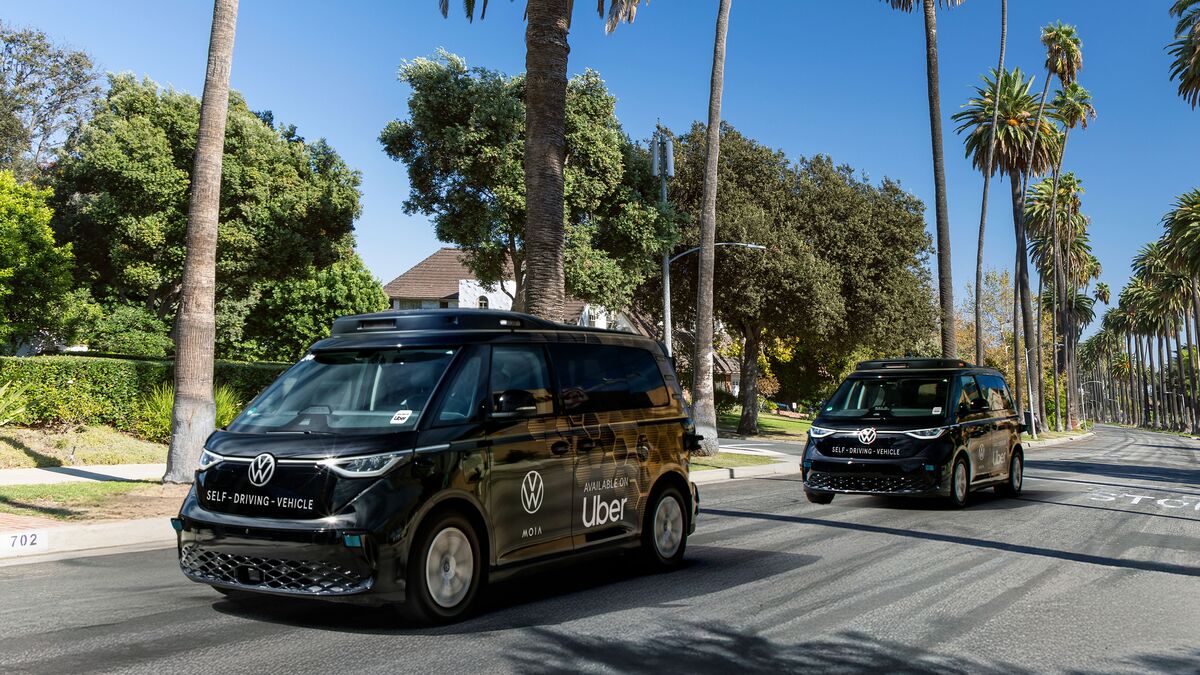
Pilot Program Launches on Public Roads
Volkswagen Group has started real-world testing of its autonomous ID. Buzz vehicles in Los Angeles, marking a significant step toward commercial robotaxi services in the United States. The initial rollout includes a fleet of test vehicles now operating on city streets, with plans to scale to over 100 units during the validation phase.
This deployment is part of a broader collaboration with ride-hailing platform Uber, first announced in 2025. The goal is to gradually integrate autonomous electric vans into Uber’s network, with public ride availability expected by late 2026.

Partnership Strategy and Market Positioning
The initiative reflects Volkswagen’s strategy to combine its electric vehicle platform with advanced autonomous systems through its mobility subsidiary, MOIA. The U.S. division, now operating as MOIA America, is leading the testing and commercialization efforts.
Company executives describe Los Angeles as a strategic launch location due to its scale, traffic complexity, and cultural openness to new mobility solutions. By partnering with Uber, Volkswagen gains access to an established user base, potentially accelerating adoption once the service goes live.
Safety-First Testing Approach
Although the vehicles are designed for high levels of automation, the current testing phase still includes human oversight. Each robotaxi is equipped with a trained safety operator seated behind the wheel, ensuring immediate intervention if needed.
This controlled rollout allows engineers to collect real-world driving data while validating system performance in complex urban environments. The testing period is expected to play a critical role in refining both software behavior and operational safety protocols.
Advanced Sensor and Computing System
At the core of the ID. Buzz robotaxi is a comprehensive sensing and decision-making architecture. Each vehicle is equipped with 27 sensors, including:
- 13 cameras for visual perception
- 9 LiDAR units for precise distance mapping
- 5 radar systems for object detection in various conditions
These inputs are processed by a centralized onboard computer developed with technology from Mobileye. The system continuously analyzes surroundings and determines appropriate driving actions, including responses to unpredictable scenarios such as emergency vehicles or sudden obstacles.
Designed for SAE Level 4 Autonomy
Volkswagen has indicated that the ID. Buzz autonomous platform is engineered to meet SAE Level 4 standards, meaning the vehicle can handle most driving tasks without human intervention under defined conditions.
Key features supporting this capability include remote monitoring systems and built-in safeguards for handling rare or complex situations. While the technology is not yet fully deployed without human supervision, the long-term objective is to operate these vehicles without a driver present.
Interior Layout Focused on Ride-Hailing
The cabin configuration of the robotaxi reflects its intended use case. Instead of a traditional front passenger seat, the space has been repurposed to include a dedicated luggage area, improving practicality for riders.
The vehicle offers four passenger seats, creating a layout optimized for shared mobility rather than private ownership. Although a driver seat remains installed during testing, it is expected to become redundant once the service transitions to fully autonomous operation.
Scaling Plans and Future Deployment
Looking beyond Los Angeles, Volkswagen and Uber aim to expand the robotaxi service to additional U.S. cities. The long-term plan involves deploying thousands of autonomous ID. Buzz vehicles across multiple urban markets.
However, scaling will depend on regulatory approvals, continued safety validation, and infrastructure readiness. Urban environments present unique challenges, including traffic density and varying local regulations, all of which must be addressed before wider rollout.

Industry Context and Competitive Landscape
Volkswagen’s entry into autonomous ride-hailing comes amid increasing competition from both traditional automakers and technology companies. While several players are pursuing similar goals, success will depend on balancing safety, cost efficiency, and user trust.
By combining electric propulsion with autonomous capabilities, Volkswagen is positioning the ID. Buzz as part of a broader shift toward sustainable and shared mobility solutions. The partnership with Uber could prove critical in bridging the gap between technology development and real-world adoption.
Recommend Reading: Zoox Expands Robotaxi Service to Austin and Miami in 2026


Share:
Walmart Expands Its EV Fast-Charging Network Across the U.S.
Tesla Reportedly Working on Smaller, Lower-Cost Electric SUV