

A Major Step Toward Easier EV Charging

Electrify America, one of the largest electric vehicle fast-charging networks in the U.S., has officially integrated real-time charger availability into Google Maps.
The new feature, which went live earlier this week, allows EV drivers to see instantly which chargers are free—without having to switch between multiple apps.

Until now, users had to open the Electrify America (EA) app separately to check station status. With this new integration, Google Maps now displays up-to-the-minute information for every EA charging site, making trip planning simpler and more seamless.

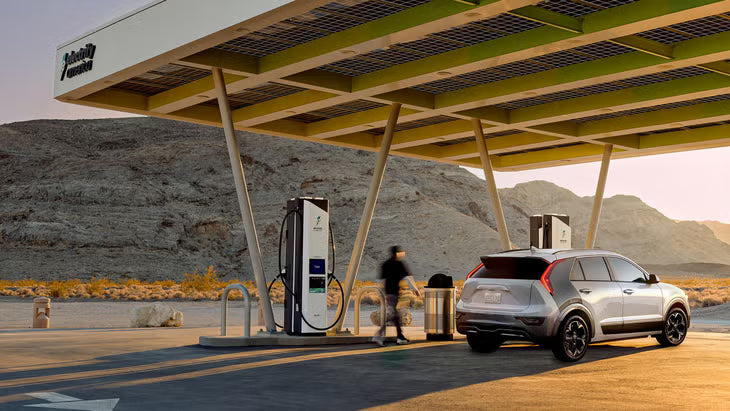
ElectrifyAmerica charging station


Simplifying the Charging Experience

For drivers tired of juggling countless apps, this update offers a big relief. Since Electrify America chargers support card payments, drivers who rely on Google Maps may no longer need the dedicated EA app to locate and access chargers.

By comparison, while Tesla Supercharger stations appear on Google Maps, real-time charger availability is not yet displayed for those locations. Electrify America’s move gives it a usability edge—especially for non-Tesla drivers looking for convenience and reliability.


Detailed Station Information at a Glance

When users tap an Electrify America station on Google Maps, they can now see:

  • Charger types available (CCS, CHAdeMO, or J1772)

  • Number of active connectors

  • Maximum charging power for each connector type

Electrify America’s current network includes 50-kilowatt CHAdeMO chargers and up to 400-kilowatt CCS fast chargers, providing some of the fastest public charging options available. Select locations even feature Level 2 J1772 chargers or pilot units supporting both CCS and NACS connectors, ensuring compatibility with an expanding range of EV models.


Boosting Confidence in Going Electric

EV adoption is accelerating, and with it comes the expectation of a seamless charging experience,” said Robert Barrosa, president and CEO of Electrify America.
He added, “By integrating real-time charging data, we’re empowering drivers with confidence—giving them access to accurate, up-to-date information right at their fingertips.

The update aligns with EA’s broader mission: to make charging as simple and dependable as fueling a gas car.


Expanding Plug & Charge Compatibility

Beyond the Google Maps integration, Electrify America continues to roll out Plug & Charge functionality—allowing compatible vehicles to start charging automatically once plugged in, with payment handled behind the scenes.

Currently, Plug & Charge is supported by Audi, BMW, Ford, Lucid, Mercedes-Benz, Nissan, Porsche, and Volkswagen, with more automakers joining soon. Rivian also announced that its R1T and R1S models will gain Plug & Charge capability through an upcoming software update.

This feature eliminates the need for RFID cards or mobile apps—further streamlining the EV ownership experience.

Electrify America


Nationwide Coverage and Future Growth

According to data from the U.S. Department of Energy’s Alternative Fuels Data Center, Electrify America operates 1,090 DC fast-charging stations across the country, offering a total of 5,199 DC fast-charging ports.

The company continues to expand its footprint in urban centers and along major highways, helping to close gaps in the public charging infrastructure.

With the addition of real-time charger availability on Google Maps and broader Plug & Charge adoption, Electrify America is positioning itself as a key player in improving EV accessibility and driver confidence across the U.S.

Recommend Reading: Comparing EV Charging Stations: Tesla Supercharger vs Electrify America, ChargePoint & More
1 Kommentar

  • EV Driver
    • EV Driver
    • 23. Oktober 2025 um 14:07

    At busy chargers (most of them), the data shown on Google Maps is still nearly useless. “1/4” usually means someone just finished charging, and it will go back to “0/4” in a minute or two.

    There is a detailed writeup on the flaws with the EA charger reporting here: https://frequal.com/Perspectives/FirstAndLastIndependentEaChargerAudit.html

    The article also shows how in LA, you only have a real chance of pulling up and charging at an EA charger between 3AM and 6AM!

    This will only change if we lobby EA to restore detailed API information so we can have good charging tools again. Quick links are at the end: https://frequal.com/Perspectives/FirstAndLastIndependentEaChargerAudit.html

Hinterlassen Sie einen Kommentar

Bitte beachte, dass Kommentare vor der Veröffentlichung freigegeben werden müssen.

Diese Website ist durch hCaptcha geschützt und es gelten die allgemeinen Geschäftsbedingungen und Datenschutzbestimmungen von hCaptcha.

FAQs – DC-Schnellladen der Stufe 3

Was ist DC-Schnellladen der Stufe 3 für Elektrofahrzeuge?

Beim Laden der Stufe 3, auch als DC-Schnellladen (DCFC) bekannt, wird Gleichstrom mit hoher Leistung (typischerweise 50 kW bis 350 kW) bereitgestellt, um die Batterie eines Elektrofahrzeugs schnell aufzuladen. Im Gegensatz zum Laden der Stufen 1 und 2 wird beim DC-Schnellladen das Bordladegerät umgangen, wodurch eine deutlich schnellere Energieübertragung ermöglicht wird.

Wie schnell ist das DC-Schnellladen der Stufe 3 im Vergleich zum Laden der Stufe 2?

Ladegeräte der Stufe 2 (240 V Wechselstrom) erhöhen die Reichweite normalerweise um 20–30 Meilen pro Stunde, während Gleichstrom-Schnellladegeräte der Stufe 3 die Reichweite in 20–40 Minuten um 100–300 Meilen erhöhen können, je nach Batteriekapazität des Elektrofahrzeugs und Ladeleistung.

Schädigt Schnellladen der Stufe 3 die Batterien von Elektrofahrzeugen?

Häufiges DC-Schnellladen kann aufgrund höherer Wärmeentwicklung und schnellerer Ladezyklen die Batterieleistung mit der Zeit beschleunigen. Moderne Elektrofahrzeuge verfügen jedoch über Batterie-Wärmemanagementsysteme , die die Auswirkungen minimieren. Gelegentliches Schnellladen ist sicher und bequem für Roadtrips.

Welche Steckertypen werden für das DC-Schnellladen der Stufe 3 verwendet?

Die wichtigsten Schnellladeanschlüsse für Elektrofahrzeuge in Nordamerika sind:

  • CCS (Combined Charging System) – von den meisten Automobilherstellern weithin übernommen
  • CHAdeMO – wird hauptsächlich von älteren Nissan LEAF-Modellen verwendet
  • NACS (Tesla-Stecker) – wird jetzt von mehreren Marken übernommen (Ford, GM, Rivian usw.)
Wie hoch ist die maximale Leistungsabgabe von DC-Schnellladestationen der Stufe 3?

Die meisten öffentlichen Gleichstrom-Schnellladegeräte haben eine Leistung von 50 bis 150 kW , während Ultraschnellladegeräte 250 bis 350 kW erreichen können. Tesla Supercharger V3 liefern bis zu 250 kW , und kommende Ladegeräte der nächsten Generation könnten für schwere Elektrofahrzeuge über 500 kW leisten.

Wie viel kostet das DC-Schnellladen der Stufe 3?

Die Preise variieren je nach Netz und Standort. Die Kosten basieren in der Regel auf einer Gebühr pro kWh , pro Minute oder einer Pauschalgebühr. In den USA liegen die Tarife typischerweise zwischen 0,25 und 0,60 US-Dollar pro kWh . Dies ist zwar teurer als beim Laden zu Hause, aber im Vergleich zu den Benzinkosten wettbewerbsfähig.

Wo finde ich in den USA Gleichstrom-Schnellladestationen der Stufe 3?

Gleichstrom-Schnellladegeräte finden sich häufig entlang von Autobahnen, Raststätten, Einkaufszentren und Ladestationen für Elektrofahrzeuge wie Tesla Supercharger, Electrify America, EVgo und ChargePoint. Apps wie PlugShare und ChargeHub helfen Fahrern bei der Suche nach Schnellladestationen.

Können alle Elektrofahrzeuge die Gleichstrom-Schnellladefunktion der Stufe 3 nutzen?

Nicht alle Elektrofahrzeuge sind kompatibel. Einige Plug-in-Hybrid-Elektrofahrzeuge (PHEVs) und ältere Modelle verfügen nicht über die Fähigkeit zum DC-Schnellladen. Die maximale Ladegeschwindigkeit hängt auch von der Ladekapazität des Fahrzeugs ab, die zwischen 50 und 270 kW liegen kann.

Wie wirkt sich das Wetter auf die Ladegeschwindigkeit von DC Level 3 aus?

Extreme Kälte oder Hitze beeinträchtigen die Temperaturregelung der Batterie und verlangsamen die Schnellladegeschwindigkeit. Elektrofahrzeuge konditionieren die Batterie häufig vor der Ankunft an einer Schnellladestation, um die Ladeeffizienz bei winterlichen oder sommerlichen Bedingungen zu optimieren.

Wie sieht die Zukunft der DC-Schnellladetechnologie der Stufe 3 aus?

Die Zukunft umfasst ultraschnelle Ladegeräte (500 kW+), die flächendeckende Einführung von NACS-Anschlüssen und die Vehicle-to-Grid-Integration (V2G) . Mit dem Ausbau der EV-Infrastruktur wird das Laden der Stufe 3 für Langstreckenfahrten und schwere Elektro-Lkw noch wichtiger.

EV-Neuigkeiten

Alle anzeigen

Tesla Drops Lane-Centering From New Model 3 and Model Y Orders in the U.S.

Tesla Drops Lane-Centering From New Model 3 and Model Y Orders in the U.S.

Tesla has removed Autosteer from all new Model 3 and Model Y trims in the U.S., leaving only adaptive cruise control as standard. The move pushes drivers toward Full Self-Driving subscriptions and has sparked backlash.

Weiterlesen

Mercedes GLC EV Demand Surges as Orders Stretch Into 2026

Mercedes GLC EV Demand Surges as Orders Stretch Into 2026

Mercedes-Benz’s new electric GLC SUV is off to a strong start, with demand exceeding expectations and orders extending into 2026, driven by long range, fast charging, and familiar premium appeal across key European markets.

Weiterlesen

Scout’s Direct Sales Plan Faces Legal Challenge Over Hybrid EV Definition

Scout’s Direct Sales Plan Faces Legal Challenge Over Hybrid EV Definition

Scout Motors’ plan to sell extended-range electric trucks directly to consumers faces a legal challenge in Colorado, where dealers argue EREVs blur EV definitions and violate franchise laws, potentially reshaping direct sales rules.

Weiterlesen