





A Rapid Milestone in Network Expansion
Two years after its launch, Ionna has marked a significant point in its U.S. rollout by completing its 100th charging location. Backed by a consortium of major automakers, the company focuses exclusively on deploying 400 kW DC fast chargers, positioning itself in the high-power segment of the charging market.

Rethinking Construction Timelines
Building a conventional fast-charging site often takes several weeks or longer, creating bottlenecks for operators trying to scale. In contrast, Ionna’s latest project demonstrates a sharply reduced timeline.
At a new location in Oklahoma City’s Bricktown district, infrastructure firm 3V3i completed the physical build of a charging station in just five working days. This achievement cuts its own previous construction time in half and sets a new reference point for how quickly such facilities can be assembled.
The Methods Behind the Speed
The accelerated timeline was not the result of a single innovation but rather a combination of coordinated approaches. According to the contractor, the project relied on prefabricated system components, a tightly integrated engineering and construction workflow, and a simplified on-site installation process.
A representative from 3V3i emphasized that reducing deployment time is a critical factor for scaling EV infrastructure. By manufacturing key elements in advance and minimizing on-site complexity, operators can both lower costs and bring new capacity online more quickly.
What Was Built—and What’s Still Pending
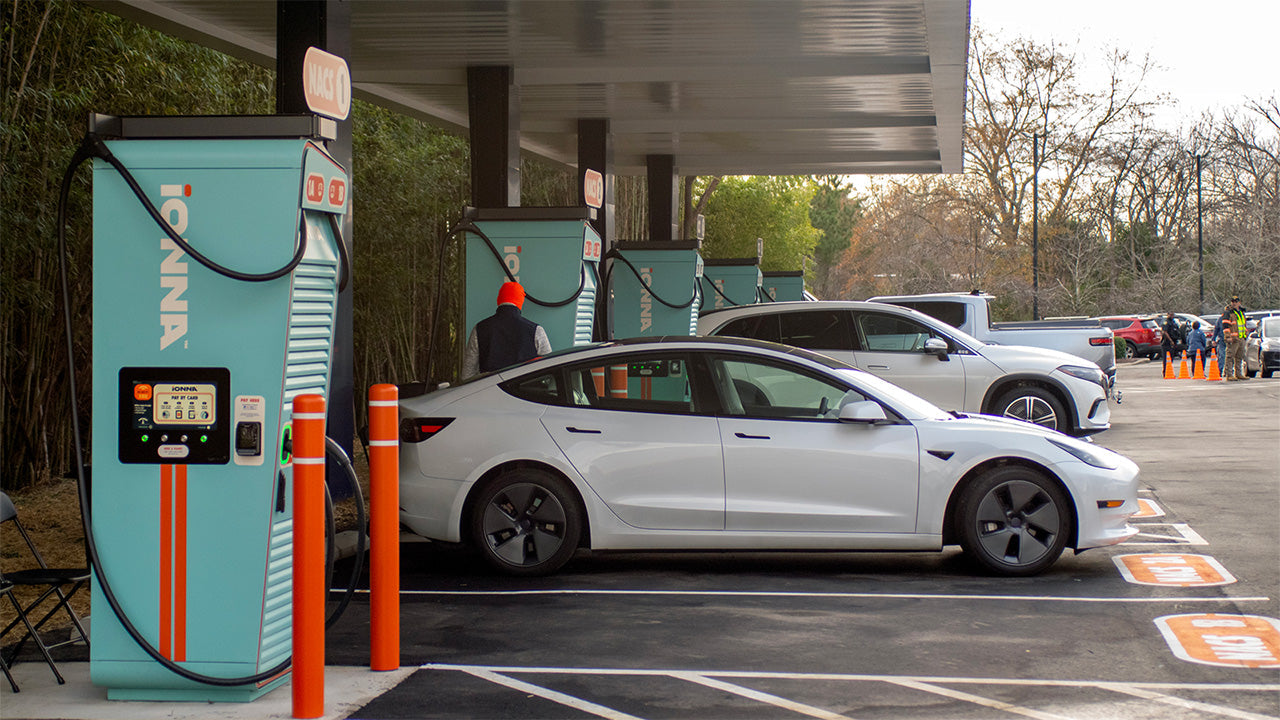
Despite the rapid construction, the station is not yet operational. Visual documentation from the site shows that the hardware installation is largely complete. The location includes three Alpitronic HYC400 charging units, equipped with a total of six connectors—four CCS and two NACS cables.
These chargers integrate power electronics directly within the units, eliminating the need for separate external cabinets. While this design simplifies installation, final activation still depends on additional steps such as grid connection, testing, and regulatory approvals.
As of now, the station has not appeared on Ionna’s official network map, and third-party platforms list it as “Coming Soon.”
Scaling Ambitions Beyond a Single Site
The Oklahoma City project is part of a broader and aggressive expansion strategy. Since launching its first stations in December 2024, Ionna has brought nearly 1,000 charging bays into service. Of those, 212 were added in 2025 alone, indicating an accelerating rollout pace.
Looking ahead, the company has outlined a target of at least 30,000 operational charging bays by 2030. Progress toward that goal is already underway, with approximately 1,000 bays completed, 4,700 under contract, and around 1,500 currently being built.

Implications for the EV Charging Industry
The ability to compress construction timelines from months to days could have wide-ranging implications for the charging sector. Faster deployment means operators can respond more quickly to demand, reduce capital tied up in projects, and expand coverage in underserved areas.
However, it is equally important to distinguish between construction completion and full commissioning. While the five-day build highlights efficiency gains in physical installation, the total time required to make a station fully operational still includes external dependencies such as permitting and grid interconnection.
Even with these caveats, the project demonstrates that significant improvements in deployment speed are achievable. As competition intensifies among charging networks, approaches like prefabrication and integrated design may become increasingly standard.
Recommend Reading: Ionna Expands Its U.S. Fast-Charging Network With Major California Investment










Share:
What Tesla Ending Model S and X Means for Lucid Buyers
Why Jay Leno Thinks Tesla Semi’s Key Edge Is Operating Cost