
EV Sales Surge to Record High

California’s electric vehicle (EV) market reached a new milestone in the third quarter of 2025. Nearly 29.1% of all new cars sold were fully electric, marking the highest share in the state’s history. According to data from the California Energy Commission (CEC), that translates to 124,755 zero-emission vehicles (ZEVs) delivered between July and September.

The record was driven by a combination of strong consumer demand and policy timing. Many buyers hurried to finalize purchases before federal EV tax credits expired at the end of the quarter, temporarily boosting sales numbers across the board.

California Q3 EV Sales in 2025


Newsom Celebrates as State Pushes Back Against Federal Rollbacks

Governor Gavin Newsom celebrated the record-breaking quarter as evidence of California’s continued leadership in clean transportation. “Nearly a third of new cars in the world’s fourth-largest economy are now zero-emission,” Newsom said. “While the federal government steps back, California is moving forward with innovation and cleaner air.”

The governor’s remarks also referenced recent policy rollbacks under President Trump, including cuts to EV purchase incentives and delays in nationwide charger funding. Despite those challenges, California has maintained its commitment to reach 100% zero-emission new vehicle sales by 2035.


Charging Network Expands to Support Growth

Behind California’s EV success is a rapidly expanding charging network. The CEC reports that over 200,000 public charging points are now available across the state, in addition to more than 800,000 home and workplace chargers.

CEC Commissioner Nancy Skinner described this as a “defining moment,” noting that most Californians now live within a 10-minute drive of a fast charger. She also emphasized the lifestyle benefits of EV ownership — no more “smelly gas stations or oil changes,” as she put it.


New Regulations Aim to Improve Charger Reliability

To ensure charging remains dependable, California implemented the nation’s first charger reliability and reporting standards on October 8, 2025. The rules require operators to maintain a minimum uptime threshold and report performance data regularly to the CEC.

At the same time, the state approved $10 million in new grants to install more than 1,000 Level 2 chargers, focusing on low-income communities and multi-unit housing. These initiatives aim to close accessibility gaps while improving the overall charging experience.


Federal Incentive Expiration May Slow Q4 Momentum

Analysts caution that the Q3 spike may not last. The surge was largely driven by buyers racing to qualify for federal incentives before they expired. Compared with Q2, EV sales jumped roughly 30%, but a short-term cooldown is expected in Q4 as the market adjusts.

Still, California’s long-term trajectory remains strong. As more automakers roll out affordable EV models, the state’s average EV transaction price continues to drop.

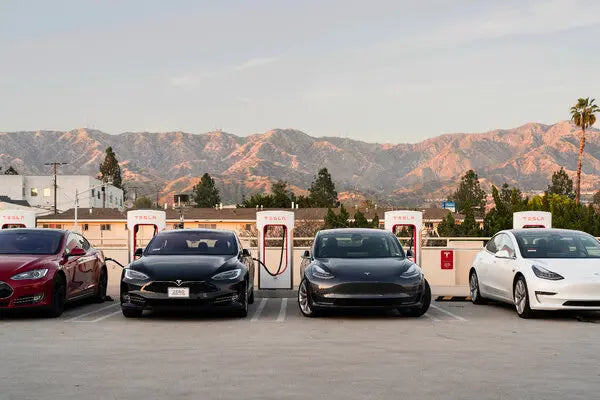
California's Level 3 DC Tesla Super Charging Station


More Models, More Choices

California currently leads the nation with 146 EV models available, up from 105 a year ago. This growing variety — from budget hatchbacks to high-performance SUVs — gives buyers more flexibility than ever.

In addition, new funding under the National Electric Vehicle Infrastructure (NEVI) Program will add 64 new fast-charging stations along major travel corridors. Several older sites are also slated for upgrades or replacement to improve reliability.


California Keeps Leading the Transition

Despite national headwinds, California’s progress shows how consistent state policies can sustain EV growth. With its infrastructure, incentives, and consumer adoption all moving in sync, the state is on track to reach 30% EV share as early as next year.

California’s clean transportation strategy is clear: keep charging forward — even when Washington slows down.

Recommend Reading: Tesla Launches First Fully Off-Grid Solar Supercharger Station in California
FAQs

1. How much does it cost to install a home EV charger in California?

Installing a Level 2 home EV charger in California typically costs between $500 and $2,500, depending on wiring, electrical panel upgrades, and labor. Hardware alone ranges from $400–$800, while installation fees can add $600–$1,700. In high-cost regions like Los Angeles and the Bay Area, total expenses may be on the higher end.

2. What rebates and incentives are available for EV chargers in California?

California offers some of the nation’s most generous EV charger rebates:

  • Up to $500–$1,500 off home charging equipment in participating regions.
  • Rebates for equipment purchase or installation, plus special time-of-use (TOU) charging rates.
  • Covers 30% of installation costs (up to $1,000) for residential EVSE (Electric Vehicle Supply Equipment).
3. How long does it take to charge an EV at home in California?
  • Level 1 (120V standard outlet)3–5 miles of range per hour, requiring 20–40 hours for a full charge.
  • Adds 20–40 miles per hour, charging most EVs in 6–10 hours overnight.
  • Can deliver an 80% charge in 20–40 minutes, depending on vehicle and station output.
4. What are the main public EV charging networks in California?

California has the largest EV charging network in the U.S., supported by:

  • (exclusive to Tesla, expanding to other EVs via NACS).
  • (CCS and CHAdeMO connectors, located on highways and retail hubs).
  • (urban fast charging, shopping centers).
  • (widely available workplace and commercial chargers).

Apps like PlugShare and ChargeHub help drivers locate stations.

5. How much does EV charging cost in California?
  • Home charging$0.25 per kWh on average. With TOU rates, off-peak prices can be as low as $0.10–$0.15/kWh.
  • Typically $0.20–$0.40 per kWh or billed hourly.
  • Ranges from $0.30–$0.60 per kWh, meaning a full session may cost $10–$30.
6. Can I rely only on home charging in California?

Yes, if your daily commute is within 40–60 miles, home Level 2 charging usually covers all needs. However, long-distance drivers will rely on highway networks like Tesla Supercharger and Electrify America for road trips.

7. How do time-of-use (TOU) electricity rates save money on EV charging?

California utilities such as PG&E, SCE, and SDG&E offer TOU pricing:

  • Highest electricity costs.
  • Lowest costs.
    Smart EV chargers allow scheduled charging, helping EV drivers save 30–50% on electricity bills.
8. Do I need a permit to install an EV charger in California?

Yes. Most cities, including Los Angeles, San Francisco, and San Diego, require a building permit for Level 2 charger installation. Installations must comply with NEC (National Electric Code) and local building codes. An inspection may also be required before use.

9. Does frequent DC fast charging damage EV batteries?

Using DC fast chargers often can increase battery heat, slightly accelerating long-term degradation. However, modern EVs like Tesla, Hyundai, and Lucid include advanced battery thermal management systems. For best results, use home Level 2 charging for daily needs and reserve DC fast charging for road trips.

10. What is the future of EV charging in California?
  • NACS standard adoption: California is leading the switch to Tesla’s NACS connector, set to become the universal standard.
  • Renewable energy integration: Home solar plus storage systems (e.g., Tesla Powerwall) will pair with EV charging to reduce costs.
  • Vehicle-to-Grid (V2G) technology: EVs will eventually feed power back to the grid during peak demand, turning cars into mobile energy assets.

EV News

View all

Tesla Drops Lane-Centering From New Model 3 and Model Y Orders in the U.S.

Tesla Drops Lane-Centering From New Model 3 and Model Y Orders in the U.S.

Tesla has removed Autosteer from all new Model 3 and Model Y trims in the U.S., leaving only adaptive cruise control as standard. The move pushes drivers toward Full Self-Driving subscriptions and has sparked backlash.

Read more

Mercedes GLC EV Demand Surges as Orders Stretch Into 2026

Mercedes GLC EV Demand Surges as Orders Stretch Into 2026

Mercedes-Benz’s new electric GLC SUV is off to a strong start, with demand exceeding expectations and orders extending into 2026, driven by long range, fast charging, and familiar premium appeal across key European markets.

Read more

Scout’s Direct Sales Plan Faces Legal Challenge Over Hybrid EV Definition

Scout’s Direct Sales Plan Faces Legal Challenge Over Hybrid EV Definition

Scout Motors’ plan to sell extended-range electric trucks directly to consumers faces a legal challenge in Colorado, where dealers argue EREVs blur EV definitions and violate franchise laws, potentially reshaping direct sales rules.

Read more