


Overview
Tesla has released its latest Holiday Update, continuing its annual tradition of delivering major software improvements. While past updates have mixed fun extras with practical upgrades, this year’s release leans more heavily toward genuinely useful enhancements that reinforce Tesla’s lead in automotive software. The update introduces new cabin monitoring tools, smarter navigation improvements, enhanced charging controls and a refreshed approach to convenience and safety features.
New Cabin Monitoring and Mobile App Enhancements
One of the most notable updates is the improved integration between the vehicle and the Tesla mobile app. Owners now receive automatic cabin snapshots when Dog Mode is enabled, allowing them to check on pets directly from their phones. The app also provides live updates on interior temperature, battery status and climate settings.
This deeper app-vehicle connection aligns with Tesla’s broader push toward seamless mobile control, strengthening its position as a software-centric automaker.

3D Supercharger Maps
Another major addition is the introduction of 3D Supercharger maps. These provide drivers with real-time visual information on available charging stalls, creating a faster and more intuitive charging experience. While the feature currently runs only at 18 pilot locations, Tesla is expected to expand availability if user feedback is positive.

Smarter Voice Controls and Navigation Updates
Tesla’s Grok voice assistant gains new capabilities with this update. Drivers can now edit, add or adjust navigation destinations using voice commands, reducing the need to interact with the touchscreen while driving.
The update also brings a long-requested convenience feature: users can set Home or Work locations simply by tapping anywhere on the map. Favorites can be reorganized more easily, streamlining everyday interactions with the interface.
Location-Based Charging Limits
For drivers who charge at multiple locations—such as rideshare or delivery drivers—Tesla introduces location-based charging limits. Once set, the car will automatically apply the appropriate charging cap when parked at a known location. This helps manage battery health, especially for users who want a full charge for morning shifts but prefer lower limits during the day to reduce long-term degradation.
Upgrades to Dashcam Viewer
Tesla’s Dashcam Viewer becomes more informative with additional data overlays. After installing the update, owners can see details such as vehicle speed, steering angle, and the status of driver-assistance systems directly within recorded footage. These added insights can be especially helpful when reviewing incidents or providing evidence after a collision.
Entertainment and Customization Features
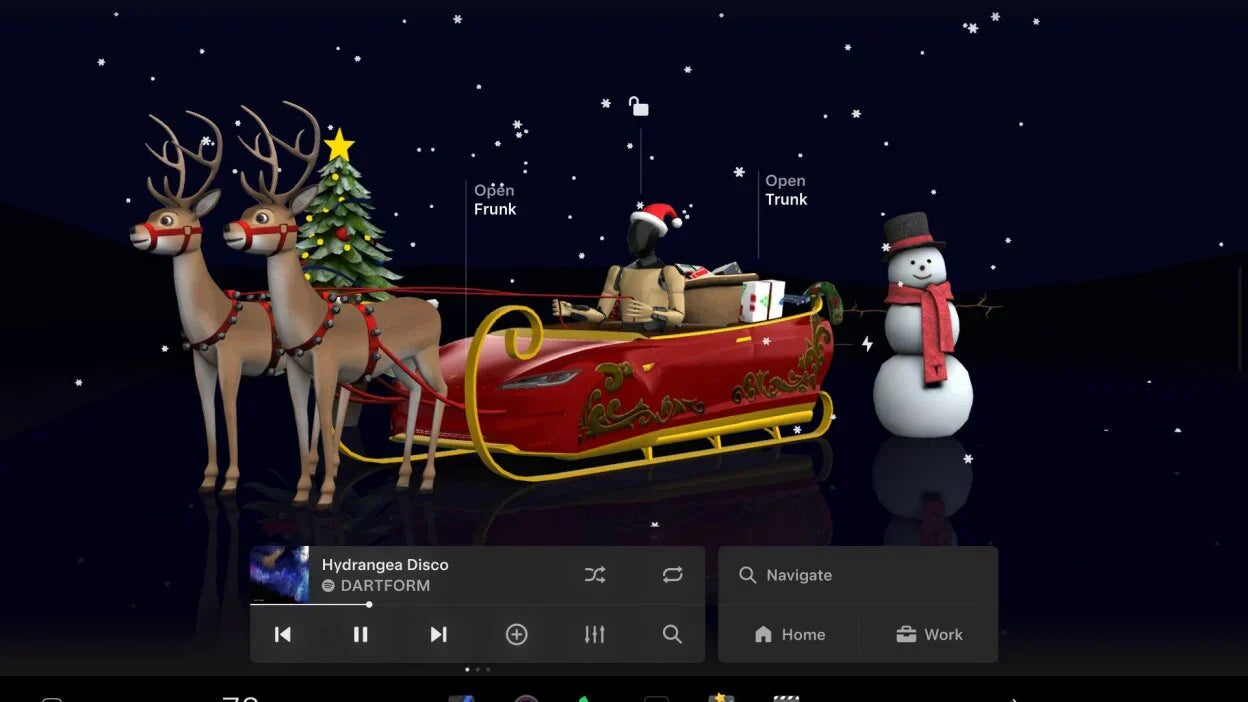
Tesla maintains its tradition of holiday fun with new lighthearted features. Santa Mode transforms the car’s on-screen model into Santa’s sleigh and adds festive characters around the vehicle visualization. Owners also gain new virtual wraps, custom license plates and selfie tools with filters and stickers, creating playful personalization options.
New Convenience and Safety Alerts
Tesla has added a safety-oriented alert that triggers a chime a few seconds after closing the doors if the system detects a phone key, or another phone, left inside the cabin. Drivers can now enable or disable the wireless charging pad manually as well.
For users in HOV-eligible states, the update includes the ability for the car to automatically select HOV lanes based on local rules, time of day, passenger count and geographic restrictions.

Looking Ahead
With tax incentives no longer available for many Tesla models, software quality plays an increasingly important role in influencing buyer decisions. The Holiday Update reinforces Tesla’s software leadership and showcases how ongoing over-the-air improvements continue to shape the ownership experience.
Recommend Reading: Tesla FSD Shows Surprising Defensive Maneuvers in Controlled Stress Test
Share:
New Mercedes GLB EV Targets Long-Range Efficiency in a Compact SUV
Modified Rivian R1T Aims for EV Cannonball Record With Dual-Battery Setup