


Overview
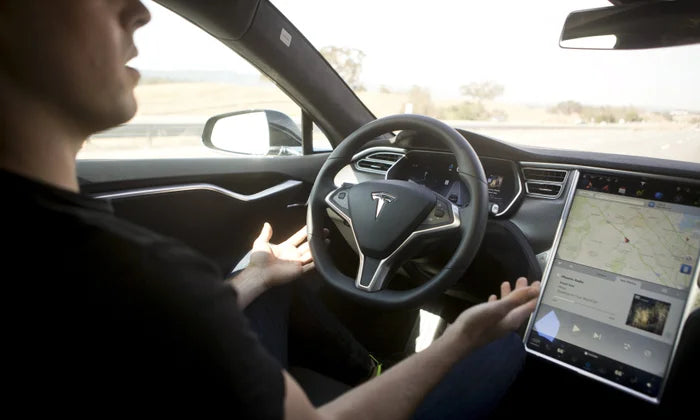
Tesla’s Full Self-Driving (FSD) continues to face regulatory hurdles—especially in Europe—but its real-world behavior remains a subject of intense interest. Designed to manage city streets using only onboard cameras, FSD often goes beyond the capabilities of typical highway-assist systems. A recent controlled experiment demonstrates how the system reacts when confronted with simulated aggressive driving, and the results show both progress and ongoing concerns.

How the Test Was Conducted
Out of Spec Reviews and Dirty Tesla collaborated to evaluate FSD’s reactions in a closed track environment. With no other traffic present, the team staged multiple scenarios involving a second car behaving aggressively toward an FSD-enabled Model 3.
Their goal was to push the system’s perception and collision-avoidance logic. The outcome? FSD responded more dynamically than many human drivers might under similar pressure.
FSD’s Defensive Steering and Swerving
In one test, the second car repeatedly attempted to sideswipe the Model 3. Rather than freezing or braking in place, the Tesla quickly moved laterally to avoid contact. The evasive maneuver was smooth, controlled, and more decisive than what an average driver might achieve in the same moment.
After several confrontations, the Model 3 made an even more unexpected decision: it executed a full U-turn to avoid continuing in the same direction as the hostile vehicle. This suggests that FSD’s path-planning logic may weigh repeated threats and choose a new route when the current one becomes unsafe.
Response to Tailgating and Head-On Approaches
When the second vehicle overtook the Tesla and then slowed down aggressively, FSD increased its following distance—sometimes by easing off the accelerator, other times by braking gently.
The system also reacted early to an oncoming head-on approach. It braked well in advance, showing strong hazard detection at long range, even with no radar or lidar support.
In lower-intensity simulations, like a parked vehicle suddenly pulling out, the Tesla again demonstrated prompt and controlled stopping behavior.
Off-Road Evasion and Edge-Case Performance
Perhaps the most striking moment came when the aggressor forced the Model 3 toward the edge of the roadway. Instead of maintaining its lane and risking collision, the Tesla steered onto the grass—still under driver-applied accelerator pressure—to maintain forward motion while avoiding impact.
Although such circumstances are rare, they highlight FSD’s ability to prioritize collision avoidance over strict lane discipline, a principle consistent with safe defensive driving.
Software Version and Industry Context
The test vehicle was running FSD Supervised 14.1.7, not the most recent build (14.2). Tesla remains the only automaker deploying this kind of advanced assisted-driving system at scale. While Tesla has expressed willingness to license FSD to other manufacturers, there have reportedly been no industry partners willing to adopt it, with Elon Musk citing “unworkable requirements” from potential collaborators.
Regulatory Roadblocks and Safety Concerns
Despite technical improvements, FSD remains controversial. It is still under multiple U.S. federal investigations and faces criticism over its branding, which some argue overstates its capabilities. Regulatory agencies maintain that constant human supervision is essential and warn that misuse could lead to severe consequences.
Nowhere is skepticism stronger than in Europe, where approval for public-road operation remains uncertain. It’s unclear if FSD will ever meet the region’s strict safety standards, but for now, the system continues to evolve through real-world use in the U.S.

Conclusion
Tesla’s latest FSD behaviors—especially its ability to evade hazards and adapt dynamically to threats—showcase meaningful progress. Yet the technology’s future depends not only on engineering improvements but also on public trust and regulatory acceptance. For now, FSD remains a powerful but closely scrutinized tool that is still far from fully autonomous driving.
Recommend Reading: Tesla HW3 Owners Await FSD Upgrade Commitment in 2025


Share:
Waymo Faces Growing Pushback Over Noisy Overnight Charging
Why Tesla Studied Chinese EVs—and What It Learned About Cost and Design
1 comment
Great reading