





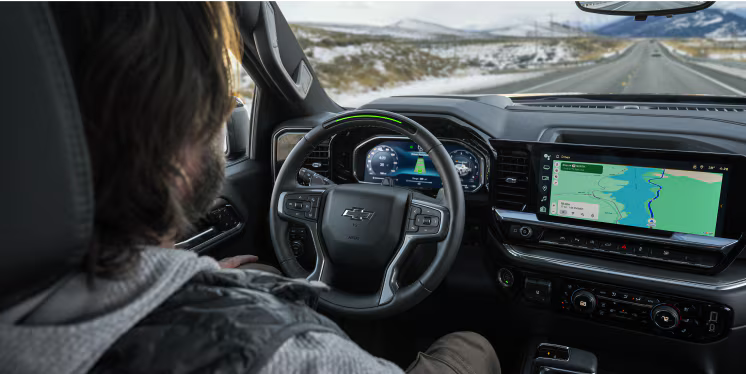
General Motors’ Super Cruise has become one of the most widely adopted hands-free driver-assistance systems in North America. With more than 625,000 active users and access to over 750,000 miles of mapped roads, it now sits alongside Ford BlueCruise and Tesla Autopilot as a leading Level 2 ADAS solution.
But widespread deployment alone does not answer a more practical question: how well does Super Cruise perform when conditions are far from ideal? To find out, we tested the system during sustained heavy rain on a long highway drive. The results were more capable—and more revealing—than expected.

Why Super Cruise Matters to GM’s Autonomy Roadmap
Super Cruise plays a critical role in GM’s long-term autonomy strategy. While it is firmly classified as a Level 2 system requiring constant driver supervision, GM has positioned it as a learning platform for future technologies.
The company has already announced plans to introduce Level 3 hands-off, eyes-off driving on the Cadillac Escalade IQ in 2028, supported by lidar. Before that can happen, however, Super Cruise must prove reliable across a wide range of real-world scenarios, including poor weather and reduced visibility.
This makes rain performance a meaningful benchmark—not a fringe edge case.
The Test Setup and Vehicle
The test vehicle was a 615-horsepower Chevy Blazer EV SS, driven on a roughly 200-mile highway round trip between New York City and Philadelphia. What was intended to be a routine drive turned into an unplanned stress test after heavy rain set in for much of the journey.
Super Cruise is standard on some premium GM EVs and optional on many others, typically followed by a $40 monthly or $400 annual subscription after a multi-year trial. As GM expands its EV lineup, the system’s consistency is becoming increasingly important to mainstream buyers.
How Super Cruise Handled Heavy Rain
Super Cruise relies on a sensor fusion approach, combining high-definition maps with cameras, radar, and GPS. Unlike Tesla’s camera-only strategy, GM’s system is intentionally conservative in when it chooses to operate.
Despite GM’s guidance discouraging use in poor weather, Super Cruise remained operational in moderate to heavy rain as long as lane markings were clearly visible. Lane centering remained stable, speed adjustments were smooth, and the system responded predictably to traffic buildup ahead.
Notably, the system disengaged instantly the moment lane markings became unclear, with no hesitation or unsafe behavior. That immediate handoff—while sometimes abrupt—felt deliberate rather than reactive.
Strengths, Weaknesses, and Honest Limitations
Super Cruise also handled automatic lane changes competently, using blind-spot monitoring and rear cameras to assess surrounding traffic. Drivers retained clear control, with easy ways to decline suggested lane changes.
However, heavy water spray from other vehicles frequently caused disengagements. Increasing following distance helped somewhat, but it exposed the system’s strong dependence on visible lane lines. Even when human drivers could comfortably interpret the road using contextual cues, Super Cruise would opt out.
This is where the system draws a clear boundary—and communicates it clearly.
How It Compares to Tesla’s FSD Approach
Tesla’s Full Self-Driving software is willing to operate with far more ambiguity, navigating urban streets and continuing when lane markings fade by relying on curbs, barriers, and environmental context. That ambition enables broader use cases but also introduces risk.
Super Cruise takes the opposite stance. When confidence drops, it disengages and demands control immediately. It does not attempt to stretch beyond its designed domain, and in that sense, it behaves honestly.
That honesty may ultimately work in GM’s favor as regulators and consumers scrutinize autonomy claims more closely.

A Measured Step Toward Level 3
Super Cruise is not autonomous driving, and it does not pretend to be. Yet during this test, it performed at the outer edge of its stated capabilities, even in conditions where many drivers would expect failure.
For highway travel in imperfect weather, the system remains useful rather than fragile—provided drivers stay alert and ready to intervene. That balance between capability and restraint offers a realistic foundation for GM’s upcoming Level 3 ambitions.
Recommend Reading: GM Faces a Hard Reality About Plug-In Hybrids in the U.S.


Share:
Tesla to End One-Time Purchase Option for Full Self-Driving Software
Tesla Model Y Remains America’s Best-Selling EV Despite Market Shifts