





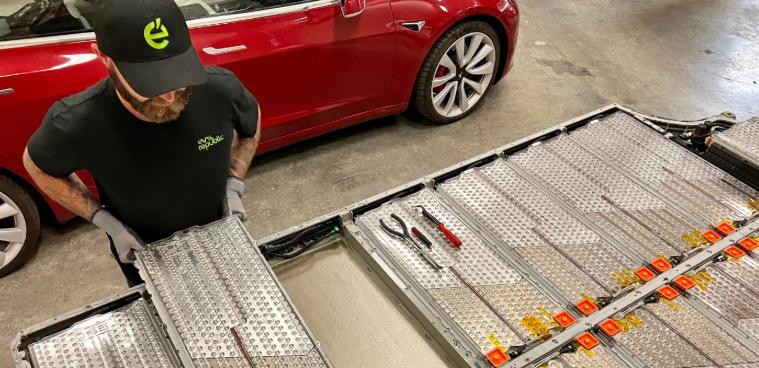
The cost of replacing an electric vehicle battery is often cited as a major reason to avoid EVs. But according to a Pennsylvania-based business owner and race car driver, that concern is frequently taken out of context. In a recent social media video, he argues that high repair bills are not unique to electric vehicles, and that similar—or even higher—costs are common in gas-powered cars.
Standing next to his snow-covered Tesla, the owner compares his experience with EV ownership to years of driving internal combustion vehicles, challenging several widely held assumptions about electric cars along the way.

Putting Battery Replacement Costs in Context
The video begins by addressing one of the most common fears around EVs: battery replacement. The owner acknowledges that replacing a Tesla battery pack can cost between $20,000 and $30,000, depending on the model and circumstances.
However, he quickly points out that large, unexpected repair bills are not exclusive to electric vehicles. As an example, he references a 2014 Infiniti QX60 he uses for long-distance travel. At just 90,000 miles, the SUV required a full transmission replacement, which cost $9,500. According to his repair estimate, a full engine replacement would have approached $20,000.
His broader point is that expensive repairs are often accepted as part of owning traditional vehicles, while similar costs in EVs are treated as uniquely alarming.
Comparing EV Repairs to High-Performance Gas Cars
The owner expands the comparison by citing high-performance gas-powered vehicles. He notes that engine replacements for cars such as V10 Mercedes-Benz models or Dodge Hellcats can “easily” reach $20,000 to $30,000. Even sports cars like Corvettes, he says, often carry engine repair costs of $15,000 to $20,000.
According to him, this reality is rarely highlighted in conversations about vehicle ownership. “When you have high-performance vehicles, they have high costs of fixing them,” he explains, regardless of whether they are powered by gasoline or electricity.
Battery Aging Versus Mechanical Wear
One distinction he emphasizes is how electric vehicle batteries age compared to engines. Battery degradation is largely time-based rather than mileage-based, which can benefit drivers who accumulate high mileage quickly. Engines, by contrast, are subject to constant mechanical wear, heat, and friction.
To manage potential costs, the owner says he plans to purchase an extended battery warranty for his Tesla, similar to the coverage he used for his Infiniti’s transmission repair. With warranty protection, he argues, the headline battery replacement cost becomes far less relevant for most owners.
Addressing Fire and Cold-Weather Concerns
Beyond repair costs, the video also tackles other persistent EV myths. One is the idea that electric vehicles are more prone to fires. The owner argues that gasoline-powered vehicles are inherently more fire-prone due to flammable fuel and complex mechanical systems.
Drawing from personal experience, he claims to have owned more than 70 vehicles and experienced multiple fires—all involving gas-powered cars. While he acknowledges that EV fires can be harder to extinguish, he maintains they are not more common than fires in internal combustion vehicles.
Cold weather performance is another frequent criticism. He concedes that EV efficiency drops significantly in low temperatures, but notes that electric cars start reliably in extreme cold, unlike gas or diesel vehicles that may require block heaters to function properly.

How Common Is EV Battery Failure?
Data from recent industry studies supports much of his argument. Battery failures in modern EVs are rare, especially in vehicles built after 2015 as battery management systems and cell chemistry have improved.
At the same time, a growing network of independent battery repair shops now offers cell-level diagnostics and repairs, often at much lower costs than dealership replacements. This expanding aftermarket further reduces the likelihood that owners will face full battery replacement bills.
Recommend Reading: Why Some EVs Are Designed to Be Charged to 100%










Share:
Kia Expands GT Lineup With More Powerful, Sport-Focused Electric Models
Tesla Expands Model Y Lineup With 400-Mile Option in Europe