





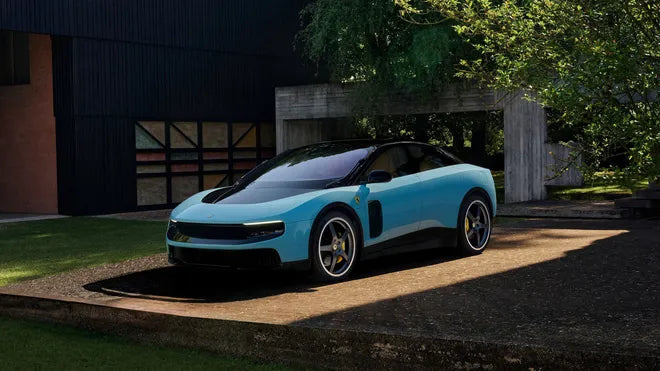
The newly unveiled Ferrari Luce EV has ignited a massive wave of global backlash centered around its highly unconventional exterior design and an astronomical estimated entry price of $640,000. While the vehicle delivers an industry-topping 1,035 horsepower from a proprietary quad-motor layout, critics and brand purists argue that its divisive aesthetic styling and extreme cost represent a significant commercial gamble in an already stalling ultra-luxury electric vehicle market.

LoveFrom Styling Sparks Design Backlash
Maranello entrusted the external look of the Ferrari Luce to the outside design firm LoveFrom, led by renowned product designers Jony Ive and Marc Newson. Utilizing a dedicated electric vehicle architecture that offered immense packaging freedom, the resulting aluminum body stretches 197.9 inches long and sits 60.8 inches high, creating proportions that are two inches longer and two inches lower than the Purosangue crossover. However, the design choices have drawn sharp criticism. The cabin sits unusually far forward, the doors utilize a center-opening configuration, and the windshield wipers remain parked in a permanent upright position against the A-pillars. While engineering teams successfully achieved the lowest drag coefficient of any roadgoing Ferrari by implementing tunnel-like front and rear spoilers alongside active grille shutters, enthusiasts have labeled the blunt exterior as a jarring departure from the organic, flowing lines historically defining the brand's legendary sports cars.
The $640,000 Price Barrier and Market Skepticism
Compounding the aesthetic controversy is the vehicle's retail cost, launching in Europe at 550,000 euros, which converts to an estimated $640,000 price tag. This extreme premium demands that buyers spend significantly more than they would on many of Maranello's highly acclaimed internal combustion engine models. The luxury automotive market has reacted with widespread skepticism to this financial positioning. The massive pricing strategy is designed to claw back the immense research and development costs of engineering a bespoke EV architecture from the ground up, while intentionally keeping production volume low to maintain brand exclusivity. Yet, industry analysts point out that asking buyers to pay over half a million dollars for an EV arrives at a perilous time. Major competitors are actively pulling back due to near-zero buyer interest; Lamborghini recently canceled its planned EV flagship, McLaren remains entirely noncommittal, and Aston Martin officially delayed its EV debut out to 2030.
Technical Specifications and Quad-Motor Powertrain
Beneath the controversial sheet metal, the Ferrari Luce EV features a highly advanced, rear-biased powertrain composed of four synchronous permanent-magnet electric motors. The front dual motors generate 282 horsepower, while the rear pair pumps out a massive 831 horsepower, culminating in a collective system output of 1,035 horsepower. Despite carrying a hefty curb weight that approaches 5,000 pounds, the vehicle achieves a 0-62 mph acceleration time of 2.5 seconds and hits 124 mph in 6.8 seconds, with a top speed capped at 193 mph. An overhead console pull handle activates a specialized launch mode that temporarily unlocks an extra 54 horsepower. To replace the emotional soundtrack of a traditional V12 engine, chief product development officer Gianmaria Fulgenzi oversaw a patented audio system that captures mechanical noise directly from inside the rear axle, processing and amplifying it through the cabin and externally based on Perfo, Tour, or Range driving modes.
Battery Capacity, Chassis Tech, and Cabin Layout
The electric motors draw power from a proprietary 122-kWh gross battery pack designed in-house to act as a structural, load-bearing element of the chassis. Operating on an 800-volt architecture, it supports DC fast charging at capacities up to 350 kW, yielding an estimated range of 330 miles under European WLTP metrics (roughly 280 miles on the US EPA cycle). The chassis utilizes four-wheel steering, 15.4-inch front brake rotors, and an F80-derived active suspension system with adaptive dampers. These components ride on massive staggered wheels—23 inches in the front and 24 inches in the rear—available in a turbine look that cuts aerodynamic drag by 5 percent. Because the platform eliminates a central transmission tunnel, the cabin easily accommodates five passengers—a historic first for a Ferrari sports car—and features the largest trunk volume in company history. The interior blends physical controls with OLED displays, including steering-wheel-mounted paddles that adjust a five-level regenerative braking system and a five-step torque delivery system designed to simulate manual gear changes.

FAQ
Why are enthusiasts criticizing the exterior design of the Ferrari Luce?
The exterior layout, penned by LoveFrom design superstars Jony Ive and Marc Newson, shifts the cabin far forward and implements blunt, geometric aerodynamic spoilers. This setup achieves a record-low drag coefficient but sacrifices the traditional, sweeping curves that brand purists expect from Maranello.
Is a price tag of $640,000 sustainable in the current luxury EV market?
The estimated $640,000 cost represents a massive commercial risk because global demand for high-end electric vehicles has slowed dramatically. Competitors like Lamborghini have canceled their EV plans due to minimal consumer interest, making Ferrari's high-pricing strategy highly controversial.
How does the Luce EV compare in size to other Ferrari models?
Built on a dedicated aluminum architecture, the vehicle measures 197.9 inches long and 60.8 inches high. This specific footprint makes it two inches longer and two inches lower than the Purosangue crossover, though it offers a much larger interior volume and the biggest trunk in brand history.
What performance metrics does the 1,035-hp quad-motor system achieve?
The permanent-magnet synchronous motors propel the 5,000-pound vehicle from 0 to 62 mph in 2.5 seconds and up to a top speed of 193 mph. Drivers can pull an overhead mechanical handle to initiate a launch mode that grants a temporary 54-horsepower boost.
When will the new electric Ferrari go on sale in global markets?
The vehicle is scheduled to officially launch in the European market later this year at a baseline of 550,000 euros. Customers located in the United States will have to wait until the second quarter of 2027 for initial vehicle deliveries to arrive.
Recommend Reading: Ferrari’s First Electric Supercar Reveals a Radical Interior Direction










Share:
Lucid Cosmos May Rival Tesla Model Y
Rivian R2 Deliveries Begin This Month