





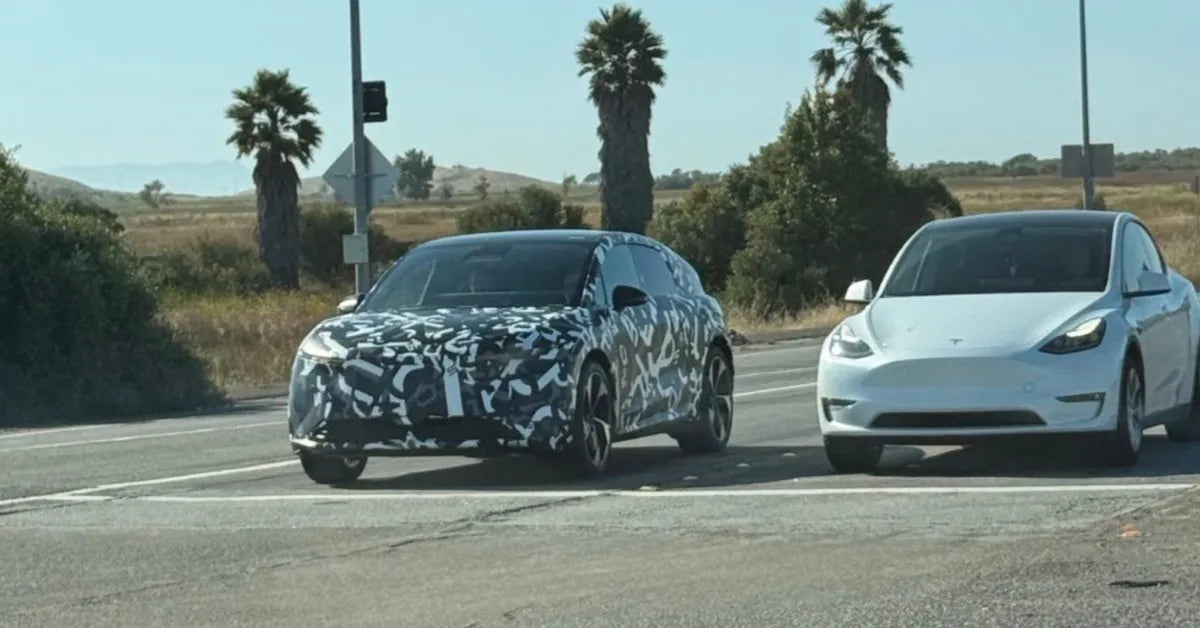
Lucid’s upcoming midsize crossover is expected to become the company’s lowest-priced EV and a direct competitor to the Tesla Model Y and Rivian R2. New prototype images suggest the vehicle may already be close to production form, offering the clearest indication yet of its size, shape, and market positioning.

Prototype Image Reveals New Design Clues
A recently shared image from outside Lucid’s Arizona manufacturing site may have provided an early look at the company’s next electric crossover. The vehicle, believed to be the upcoming Lucid Cosmos, appeared parked beside a Tesla Model Y, making it easier to estimate its proportions and overall footprint.
Although Lucid has not officially confirmed the identity of the camouflaged prototype, the vehicle closely resembles earlier teaser visuals released by the automaker. Its overall dimensions appear comparable to the Model Y, though the Lucid prototype seems to feature a lower roofline and a sleeker rear profile.
Instead of adopting a traditional upright SUV design, the crossover appears to lean toward a sportier fastback-inspired shape. The styling also shares visual similarities with the larger Lucid Gravity, though in a more compact package aimed at a broader audience.
The camouflage obscures many exterior details, but several elements remain visible. The vehicle appears to include a wide digital display stretching across much of the dashboard, along with slim front lighting signatures that match Lucid’s current design language.
Why Lucid Needs a Lower-Cost EV
The Cosmos is expected to play a major role in Lucid’s long-term business strategy. The company currently sells premium electric vehicles priced well above most mainstream competitors, limiting overall sales volume.
At present, Lucid’s least expensive model is the Air Pure sedan, which starts above $70,000. By contrast, the Cosmos is projected to launch at under $50,000, placing it much closer to high-volume EV crossovers already dominating the market.
That pricing shift is significant. Lucid has repeatedly emphasized the importance of entering more affordable segments in order to expand its customer base and improve profitability. A midsize crossover is widely viewed as one of the largest and fastest-growing categories in the global EV market.
The Tesla Model Y remains the benchmark in this space due to its pricing, charging network access, and brand recognition. Meanwhile, Rivian’s upcoming R2 is also targeting buyers looking for a practical electric SUV below luxury-tier pricing.
Lucid appears to be positioning the Cosmos directly between those products: more premium than entry-level EVs, but notably less expensive than the company’s current lineup.
Efficiency Could Become Lucid’s Main Advantage
Rather than competing purely on price, Lucid is expected to focus heavily on efficiency. The company has built its reputation around extracting more driving range from smaller battery packs, and the Cosmos may continue that approach.
According to previously disclosed targets, the crossover could deliver roughly 300 miles of driving range while using a relatively compact 69-kilowatt-hour battery. If achieved, that would place it among the more energy-efficient EVs in its class.
Lucid also plans to introduce its new Atlas drive unit in the model. While detailed specifications remain limited, the updated motor technology is expected to improve both packaging efficiency and energy consumption.
Fast-charging performance may also become a selling point. Early information suggests the vehicle could recover approximately 200 miles of range in around 14 minutes under ideal charging conditions.
Those figures would help Lucid remain competitive against rivals increasingly focused on reducing charging times rather than simply increasing battery size.
Single-Motor Version May Be Important
One unanswered question involves drivetrain configuration. Lucid has not confirmed whether the Cosmos will launch with rear-wheel drive, dual-motor all-wheel drive, or both.
The answer could significantly affect pricing. The company’s larger Gravity SUV currently uses all-wheel drive exclusively, but the Air sedan already offers a single-motor variant. Introducing a similar configuration for the Cosmos would help Lucid lower entry pricing and compete more directly with the base Tesla Model Y.
That strategy is becoming increasingly common across the EV industry. Rivian, for example, plans to offer an entry-level rear-wheel-drive version of the R2 to reach lower price points.
Lucid may ultimately need a comparable option if it hopes to expand beyond the luxury niche and attract mainstream crossover buyers.
A Critical Model for Lucid’s Future
The Cosmos may become Lucid’s most important product so far. The company has earned praise for battery efficiency and performance engineering, but high prices have limited its market reach.
A more accessible crossover could allow Lucid to enter a much larger sales category while preserving the technology advantages that distinguish the brand from competitors.
Much will depend on final pricing, production scale, and how closely the production model matches current expectations. But based on what has emerged so far, Lucid appears focused on building a more practical EV aimed at everyday buyers rather than only premium customers.

FAQ
Why is the Lucid Cosmos important for the company?
The Cosmos is expected to become Lucid’s first lower-priced mass-market EV. Analysts view it as a key step toward increasing sales volume and improving the company’s financial performance.
How much could the Lucid Cosmos cost?
Lucid has indicated the crossover should start below $50,000. That would make it substantially cheaper than the current Air sedan lineup.
Will the Lucid Cosmos compete with the Tesla Model Y?
Yes. The vehicle is expected to target the same midsize electric crossover segment currently led by the Tesla Model Y and soon joined by the Rivian R2.
What driving range is expected from the Cosmos?
Early targets suggest approximately 300 miles of range from a 69-kWh battery pack. Lucid is prioritizing efficiency rather than relying on extremely large batteries.
Could the Cosmos offer fast charging?
Lucid says the crossover may recover around 200 miles of range in roughly 14 minutes when connected to high-speed charging equipment.
Recommend Reading: Lucid Motors Appoints New CEO and Secures Additional Investment









Share:
Fast EV Charging Creates New Cost Concerns
Ferrari Luce EV price specs and backlash details