





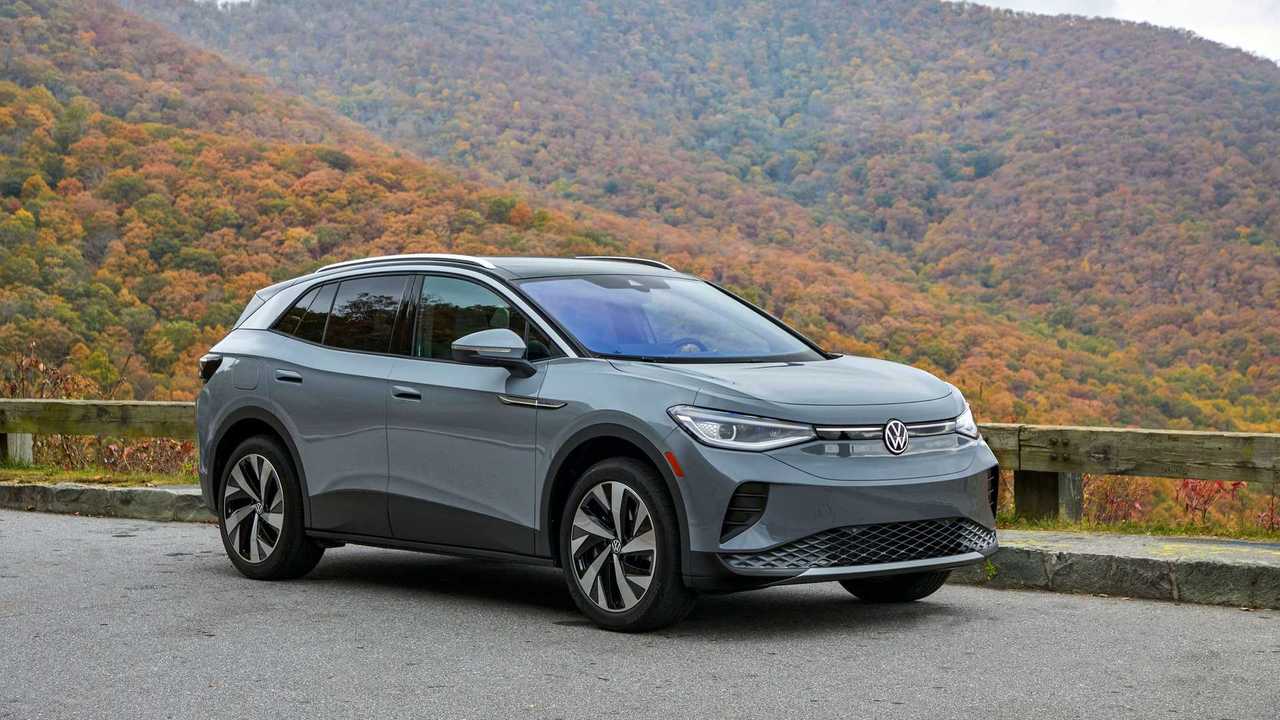
A Critical Model in Volkswagen’s EV Transition
When Volkswagen introduced the ID.4 to the U.S. market in 2021, the electric crossover was positioned as a cornerstone of the brand’s electric future. Sized to appeal to mainstream SUV buyers, it was intended to translate Volkswagen’s mass-market success into the EV era. Several years on, the ID.4 remains strategically important—but its journey has been uneven.
While incremental improvements have addressed some early shortcomings, recent time spent with the 2025 ID.4 suggests the model is now caught between early experimentation and the expectations of a rapidly maturing EV market.

Platform and Powertrain: Solid but Aging Foundations
The ID.4 is built on the MEB electric platform, a modular architecture introduced by Volkswagen Group in Europe in 2019. The platform has proven durable, supporting a wide range of vehicles across brands and even extending to Ford’s European EVs. However, it lacks the flexibility and software integration seen in newer, more advanced EV architectures.
In U.S. specification, the ID.4 uses an 82 kWh battery pack (77 kWh usable). Rear-wheel-drive versions are rated at up to 291 miles of range, while all-wheel-drive trims deliver closer to 263 miles. These figures remain competitive but no longer stand out as rivals increasingly push past the 300-mile mark.
Real-world efficiency during mixed driving hovered between 2.8 and 3.3 miles per kWh, achieved in cool conditions around 40°F, suggesting respectable energy management despite the vehicle’s size and weight.
Charging Performance and Network Access
Charging capability is one of the ID.4’s relative strengths, though it stops short of class-leading. Peak DC fast-charging reaches about 170–175 kW, allowing a 10–80% charge in roughly 30 minutes under optimal conditions. This is adequate for daily use and road trips but trails faster-charging competitors built on 800-volt systems.
Volkswagen sweetens the ownership experience with two years of complimentary charging on the Electrify America network. The vehicle also supports plug-and-charge functionality, reducing friction at compatible stations.
While the ID.4 does not yet feature a native NACS port, it can access more than 25,000 Tesla Superchargers via an adapter, significantly improving long-distance usability—even if adapters remain a less-than-ideal solution.
Driving Dynamics: Confident and Engaging
On the road, the ID.4 continues to impress. Dual-motor versions produce up to 335 horsepower and more than 400 lb-ft of torque, delivering immediate acceleration that feels strong well beyond city speeds.
Ride quality reflects Volkswagen’s traditional tuning priorities: stable highway manners, controlled body movement through corners, and consistent damping over uneven pavement. While sharper road imperfections are noticeable, the chassis never feels unsettled or unrefined.
For an electric family crossover, the ID.4 strikes a balance between comfort and responsiveness that remains competitive in its segment.
Interior Design and Software: Improvements with Lingering Friction
Few areas illustrate Volkswagen’s learning curve more clearly than the ID.4’s cabin and digital systems. Early versions were widely criticized for unstable software, slow boot times, unreliable smartphone integration, and inconsistent range predictions—issues that undermined trust among early adopters.
Those challenges triggered major restructuring within Cariad, Volkswagen’s software unit, contributing to billions in losses and delays across multiple EV programs. The company has since sought external expertise, partnering with Rivian for software architecture and Xpeng for technology development in China.
In the current ID.4, software performance has improved noticeably. The 12.9-inch central display responds quickly, graphics are sharp, and wireless Android Auto connects reliably. However, usability concerns remain.
Capacitive sliders for volume and climate controls are unintuitive, and touch-sensitive steering wheel buttons are prone to accidental inputs. A particularly controversial choice is the two-switch power window layout, which requires an extra button press to control rear windows—a cost-saving measure that frustrates many drivers.
Market Position and Value Concerns
Volkswagen plans a significant update, including rebranding the ID.4 as the ID.Tiguan, aligning it with the brand’s best-selling gas-powered SUV. Despite early setbacks, the ID.4 recorded over 22,000 U.S. sales last year, a 31% increase year over year, though demand weakened after federal tax incentives expired.
Pricing remains a challenge. The ID.4 starts at around $45,000, while higher trims can exceed $56,000. At those levels, buyers can find alternatives with faster charging, longer range, or more premium interiors—often for less money.

What the ID.4 Ultimately Represents
The ID.4 is not a failure. It is spacious, enjoyable to drive, increasingly capable on road trips, and far more refined than its earliest versions. Yet in 2026, it struggles to justify its price against newer, more advanced competitors.
More importantly, the ID.4 serves as a case study in Volkswagen’s EV evolution—highlighting the risks of moving too fast on unproven software while underscoring the company’s willingness to adapt. If Volkswagen’s next-generation EVs deliver on usability, efficiency, and integration, the ID.4 may be remembered less for its flaws and more for the lessons it provided.
Recommend Reading: Volkswagen Issues ID.4 Battery Recall as Fire Risk Prompts New Charging Guidance


Share:
Range Claims and What They Really Mean
Germany Overtook the U.S. in EV Production Last Year, New Data Shows