Ford’s 2025 sales results tell a clear story of two diverging paths. While its electric vehicle business struggled amid shifting policies and market headwinds, Ford’s hybrid lineup delivered its strongest performance ever, highlighting continued consumer appetite for electrification—just not fully electric yet.

Ford F-150


Record Hybrid Sales Signal Consumer Caution

Ford reported 228,072 hybrid vehicles sold in the U.S. in 2025, marking a 21.7% increase year over year and setting a new company record. This figure includes both conventional hybrids and plug-in hybrid models, and trucks were the standout performers.

The Maverick Hybrid exceeded 81,000 units, while the F-150 Hybrid sold nearly 85,000 trucks, underscoring how strongly hybrid technology resonates with Ford’s core truck buyers. These vehicles deliver improved fuel efficiency without demanding major changes in driving habits, charging routines, or upfront cost—advantages that matter in an uncertain EV market.


Why Hybrids Are Winning Right Now

For many consumers, hybrids represent a low-friction step toward electrification. They offer better fuel economy and lower emissions than gasoline-only vehicles while avoiding the perceived inconveniences of EV ownership, such as charging infrastructure concerns or higher purchase prices.

The contrast within Ford’s own lineup is telling. Even in its best year, the all-electric F-150 Lightning sold roughly 33,000 units, far behind the hybrid version of the same truck. However, despite their popularity, hybrids still emit significantly more CO₂ than full EVs, limiting their role as a long-term climate solution.


Ford’s EV Sales Decline Sharply in 2025

While hybrids surged, Ford’s EV sales fell 14% in 2025 to 84,113 units, down from nearly 98,000 the previous year. Several factors contributed to the decline, including reduced government incentives and strategic product decisions.

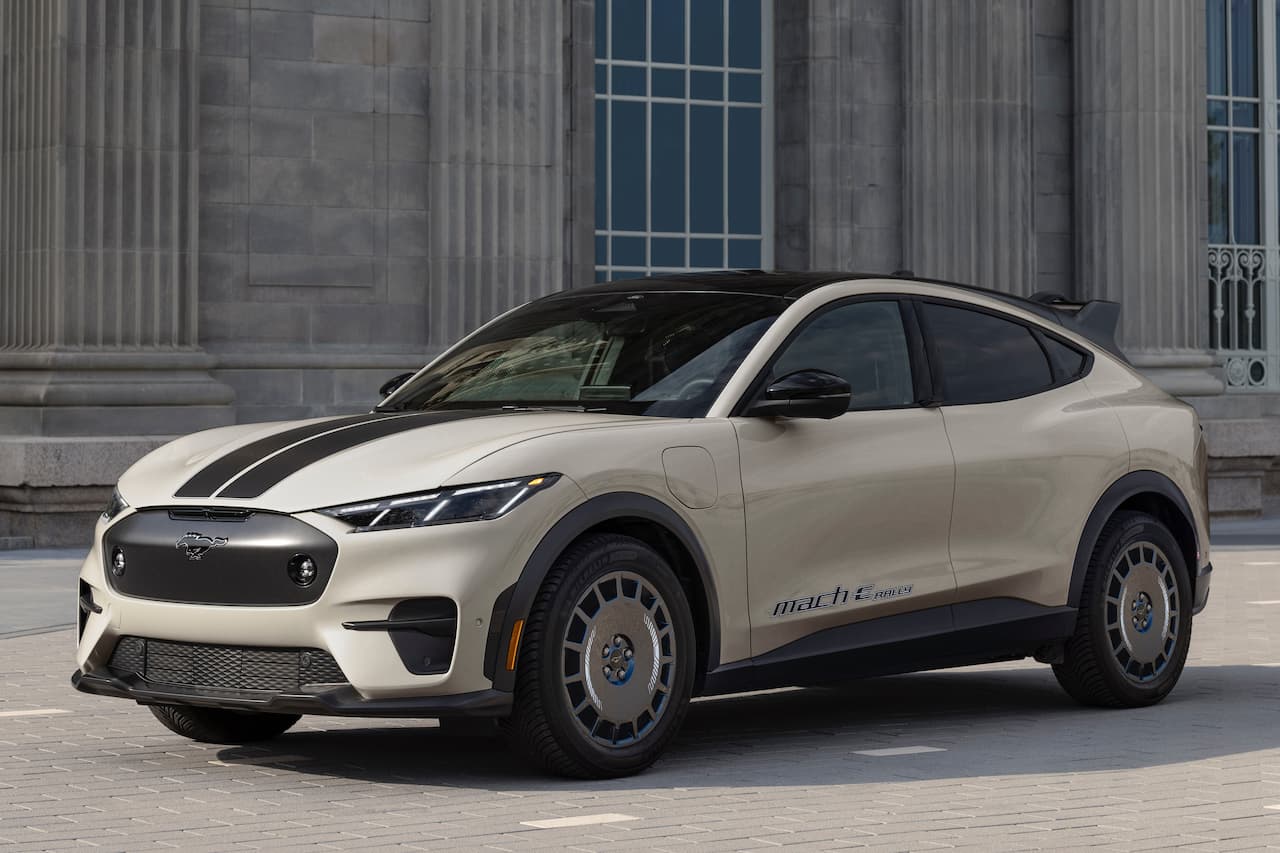
Sales of the E-Transit electric van dropped nearly 59%, and F-150 Lightning sales fell 18.5%, an expected outcome after Ford officially discontinued the model late in 2024. One bright spot remained: the Mustang Mach-E, which held steady with 51,620 units sold, maintaining its position as one of the best-selling EVs in the U.S.


Policy Shifts Reshape the EV Market

The broader EV slowdown reflects structural changes across the U.S. auto market. The expiration of the $7,500 federal EV tax credit on September 30 had an immediate and lasting impact, accelerating purchases earlier in the year while making EVs more expensive overnight.

At the same time, the Trump administration’s rollback of several clean vehicle regulations reduced pressure on automakers to rapidly electrify their fleets. These shifts collectively cooled consumer demand and gave manufacturers more flexibility to slow EV rollouts.


Ford Bets on Hybrids and a Delayed EV Reset

Ford is responding by recalibrating its strategy. The company has canceled several EV programs and is placing its long-term bet on a next-generation Universal EV Platform, expected to debut in 2027 with a $30,000 electric pickup aimed at mass-market buyers.

However, slowing down carries risks. Competitors such as General Motors already offer a broader EV portfolio, even though GM does not currently sell hybrids. Ford argues that its diversified powertrain strategy gives it an edge during periods of market uncertainty.

Ford electric truck being showcased nearby the dealer.


A Strategic Advantage—or a Temporary One?

In a recent statement, Ford said its powertrain mix enabled it to outperform GM and Stellantis in total electrified vehicle sales, combining hybrids, plug-in hybrids, and EVs. The claim highlights Ford’s ability to adapt—but also raises questions about long-term competitiveness as rivals continue expanding their EV lineups.

For now, Ford’s hybrid success offers stability. Whether it proves to be a bridge to a stronger EV future—or a detour—remains an open question.

Recommend Reading: Ford’s Affordable EV Platform Faces Uncertain Future in Europe

Hinterlassen Sie einen Kommentar

Bitte beachte, dass Kommentare vor der Veröffentlichung freigegeben werden müssen.

Diese Website ist durch hCaptcha geschützt und es gelten die allgemeinen Geschäftsbedingungen und Datenschutzbestimmungen von hCaptcha.

FAQs – Chinesische Elektrofahrzeuge für US-Elektrofahrzeugnutzer

Was ist Ford BlueCruise und wie funktioniert es?

Ford BlueCruise ist die freihändige Fahrtechnologie von Ford, die auf ausgewählten Autobahnen in Nordamerika, den sogenannten Blue Zones , verfügbar ist. Sie nutzt eine Kombination aus adaptiver Geschwindigkeitsregelung, Spurzentrierung, GPS-Kartierung und auf den Fahrer gerichteten Kameras, um freihändiges Fahren zu ermöglichen und gleichzeitig sicherzustellen, dass der Fahrer aufmerksam bleibt.

Welche Ford- und Lincoln-Fahrzeuge sind mit BlueCruise ausgestattet?

Ab 2025 ist BlueCruise für beliebte Modelle wie den Ford Mustang Mach-E, F-150 Lightning, F-150, Expedition sowie Lincoln Navigator, Aviator und Corsair verfügbar. Ford plant, die Verfügbarkeit von BlueCruise in den kommenden Jahren auf weitere Elektro- und konventionelle Fahrzeuge auszuweiten.

Wie viel kostet Ford BlueCruise?

BlueCruise bietet in der Regel eine Testphase (90 Tage bis 3 Jahre, je nach Modell) und erfordert anschließend ein Abonnement. Die Preise beginnen bei etwa 800 US-Dollar pro Jahr oder 75 US-Dollar pro Monat , wobei die Pakete je nach Fahrzeug und Händlerangeboten variieren.

Was sind Ford BlueCruise Blue Zones?

Blue Zones sind vorkartierte, geteilte Autobahnen, auf denen BlueCruise für freihändiges Fahren validiert wurde. Ab 2025 decken Blue Zones über 200.000 Meilen Autobahnen in den USA und Kanada ab, wobei Ford die Abdeckung durch drahtlose Updates erweitert.

Ist Ford BlueCruise dasselbe wie Tesla Autopilot oder GM Super Cruise?

Nein. Obwohl es sich bei allen um Fahrerassistenzsysteme (ADAS) handelt, funktioniert jedes anders. Tesla Autopilot basiert auf kamerabasierter KI , GM Super Cruise nutzt LiDAR-basierte HD-Karten und Ford BlueCruise kombiniert adaptive Geschwindigkeitsregelung, Spurzentrierung und Fahrerüberwachung . BlueCruise ist eher für praktisches und sicheres Fahren auf der Autobahn als für völlig autonomes Fahren konzipiert.

Funktioniert Ford BlueCruise bei schlechtem Wetter oder starkem Verkehr?

BlueCruise funktioniert bei Regen, Nebel und Stop-and-Go-Verkehr . Bei extremen Wetterbedingungen wie Schneestürmen oder wenn die Fahrbahnmarkierungen nicht sichtbar sind, kann die Leistung jedoch eingeschränkt sein. Das System erfordert stets die Aufmerksamkeit und Übernahmebereitschaft des Fahrers.

Kann Ford BlueCruise mit neuen Funktionen aktualisiert werden?

Ja. BlueCruise ist mit Over-the-Air-Updates (OTA) ausgestattet. Das bedeutet, dass Ford neue Funktionen veröffentlichen, Blue Zones erweitern und die Systemleistung verbessern kann, ohne dass ein Besuch beim Händler erforderlich ist. Das macht BlueCruise im Vergleich zu herkömmlichen ADAS-Systemen zukunftssicher .

Macht Ford BlueCruise ein Fahrzeug vollständig selbstfahrend?

Nein. Ford BlueCruise ist gemäß SAE-Standards als autonomes Fahrsystem der Stufe 2 eingestuft. Das bedeutet, dass es unter bestimmten Bedingungen die Freisprechfunktion bietet, der Fahrer jedoch stets aufmerksam bleiben und die Straße im Auge behalten muss.

Welche Sicherheitsmerkmale bietet Ford BlueCruise?

BlueCruise nutzt Infrarotkameras, die auf den Fahrer gerichtet sind und dafür sorgen, dass der Blick des Fahrers auf der Straße bleibt. Schaut der Fahrer zu lange weg, gibt das System Warnungen aus und bremst das Fahrzeug schrittweise ab, wenn keine Reaktion erkannt wird. Das macht es sicherer als Systeme, die die Unaufmerksamkeit des Fahrers zulassen.

Wie sieht die Zukunft der Ford BlueCruise-Technologie aus?

Ford plant, BlueCruise weiter auszubauen. Dazu gehören mehr kartierte Straßen, eine verbesserte Spurwechselautomatisierung und die Integration mit Elektrofahrzeugplattformen wie dem Mustang Mach-E und dem F-150 Lightning. Bis 2030 will Ford BlueCruise zu einem Eckpfeiler seines vernetzten Fahrzeug-Ökosystems machen und damit direkt mit Tesla FSD und GM Super Cruise konkurrieren.

EV-Neuigkeiten

Alle anzeigen

Americans Worry More About EV Range Than Cost, Survey Shows

Americans Worry More About EV Range Than Cost, Survey Shows

A Deloitte survey finds that U.S. buyers worry more about EV range and charging time than cost. Loss of the federal tax credit slowed adoption, but interest remains, especially for affordable, long-range models.

Weiterlesen

Tesla’s Cybercab Could Get Regulatory Boost From Congress

Tesla’s Cybercab Could Get Regulatory Boost From Congress

Tesla’s Cybercab aims to be a $30,000 fully autonomous ride-hailing vehicle. Congressional approval could raise production limits, but software, charging infrastructure, and branding challenges still remain.

Weiterlesen

Volvo EX60 Targets Long-Range Leadership in the Electric SUV Segment

Volvo EX60 Targets Long-Range Leadership in the Electric SUV Segment

The Volvo EX60 marks a major step in the brand’s EV reset, targeting up to 400 miles of range, rapid 800-volt charging, and advanced manufacturing. The model aims to compete directly with top electric SUVs in performance and practicality.

Weiterlesen