


A New Charging Network Gains Momentum Quickly

Ionna, a DC fast-charging network backed by several major automakers, is expanding across the United States at a pace few expected so soon. Less than a year after opening its first locations, the company is already on track to reach a milestone that took earlier charging networks far longer to achieve.

According to company executives, Ionna expects to double both its number of sites and charging stalls by the end of this year, positioning it as one of the fastest-growing charging operators in the country. The network currently operates dozens of locations nationwide, but its expansion timeline suggests rapid scaling is now firmly underway.

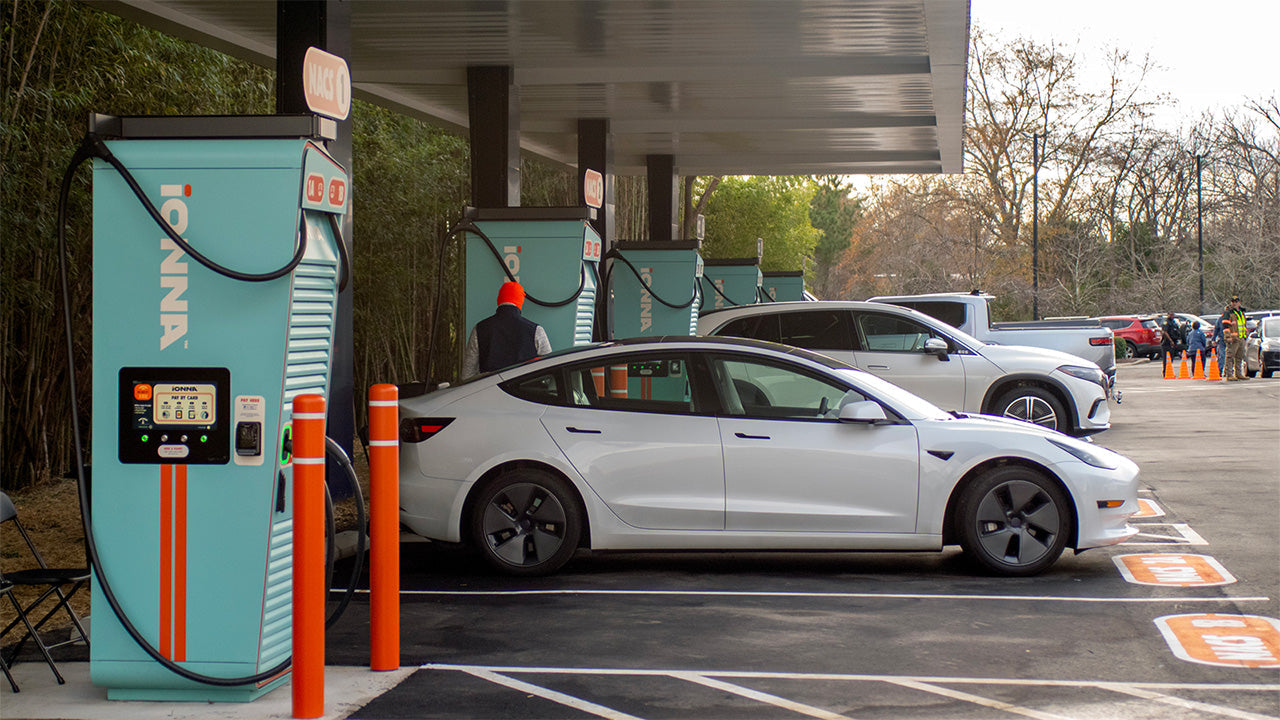
Ionna Charging Station


Doubling Locations and Charging Stalls

At present, Ionna operates 51 charging locations with 478 active fast-charging ports across the U.S. Company officials say that number will grow significantly within weeks. By the end of December, or shortly after the new year begins, Ionna expects to reach approximately 100 locations and 1,000 charging bays.

This pace of growth is notable for a network that only began operations late last year. The company has already secured contracts for more than 4,000 charging bays, with the first 1,000 scheduled to come online soon. Longer term, Ionna has committed to building 30,000 fast-charging bays by 2030, signaling confidence in sustained EV adoption.


How Ionna Compares to Early Charging Networks

Even Tesla, now synonymous with fast charging, did not scale this quickly in its early years. When Tesla launched the Supercharger network in 2012, it took more than a year to build fewer than 100 locations worldwide. Installation accelerated later, but the initial rollout was comparatively slow.

Part of Ionna’s advantage comes from timing. Fast-charging technology, supply chains, and installation processes are far more mature today. Charging hardware is now sourced from established suppliers, reducing development time. Early players like Tesla had to design and engineer systems from the ground up, which inevitably slowed deployment.


Premium Charging Sites With High-Power Hardware

Speed alone is not Ionna’s only differentiator. The company’s charging sites, branded as “Rechargeries,” are designed with driver comfort and reliability in mind. Many locations feature canopies, on-site amenities, and high-power charging stalls capable of delivering up to 400 kilowatts.

Importantly, the stalls support both CCS and NACS connectors, making them compatible with nearly all modern EVs on U.S. roads. This dual-standard approach reduces friction for drivers and positions Ionna as a network built for the current transition period, rather than betting on a single connector ecosystem.


Automaker Backing Provides Long-Term Stability

Ionna’s rapid expansion is supported by nearly a dozen automakers, giving the network both financial backing and strategic relevance. During recent media briefings, representatives emphasized that charging infrastructure must continue expanding regardless of short-term market fluctuations.

That message comes at a time when EV incentives are shrinking and political support for electrification is less certain. With the federal $7,500 EV tax credit gone, some infrastructure providers may slow investments. Ionna’s partners, however, appear committed to maintaining momentum, viewing reliable fast charging as essential to long-term EV adoption.

Ionna charging station


Building for the Next Phase of EV Growth

While EV sales growth may fluctuate year to year, charging infrastructure remains a foundational requirement. Ionna’s strategy reflects the belief that robust, well-designed fast-charging networks will outlast policy cycles and market volatility.

By combining aggressive expansion, high-power hardware, and automaker backing, Ionna is positioning itself as a serious contender in the U.S. charging landscape. If it reaches its near-term goals on schedule, it will have achieved in one year what once took the industry several.

Recommend Reading: 300-Mile EV Road Trip Using Only Free Chargers: What One Driver Learned

Hinterlassen Sie einen Kommentar

Bitte beachte, dass Kommentare vor der Veröffentlichung freigegeben werden müssen.

Diese Website ist durch hCaptcha geschützt und es gelten die allgemeinen Geschäftsbedingungen und Datenschutzbestimmungen von hCaptcha.

FAQs – DC-Schnellladen der Stufe 3

Was ist DC-Schnellladen der Stufe 3 für Elektrofahrzeuge?

Beim Laden der Stufe 3, auch als DC-Schnellladen (DCFC) bekannt, wird Gleichstrom mit hoher Leistung (typischerweise 50 kW bis 350 kW) bereitgestellt, um die Batterie eines Elektrofahrzeugs schnell aufzuladen. Im Gegensatz zum Laden der Stufen 1 und 2 wird beim DC-Schnellladen das Bordladegerät umgangen, wodurch eine deutlich schnellere Energieübertragung ermöglicht wird.

Wie schnell ist das DC-Schnellladen der Stufe 3 im Vergleich zum Laden der Stufe 2?

Ladegeräte der Stufe 2 (240 V Wechselstrom) erhöhen die Reichweite normalerweise um 20–30 Meilen pro Stunde, während Gleichstrom-Schnellladegeräte der Stufe 3 die Reichweite in 20–40 Minuten um 100–300 Meilen erhöhen können, je nach Batteriekapazität des Elektrofahrzeugs und Ladeleistung.

Schädigt Schnellladen der Stufe 3 die Batterien von Elektrofahrzeugen?

Häufiges DC-Schnellladen kann aufgrund höherer Wärmeentwicklung und schnellerer Ladezyklen die Batterieleistung mit der Zeit beschleunigen. Moderne Elektrofahrzeuge verfügen jedoch über Batterie-Wärmemanagementsysteme , die die Auswirkungen minimieren. Gelegentliches Schnellladen ist sicher und bequem für Roadtrips.

Welche Steckertypen werden für das DC-Schnellladen der Stufe 3 verwendet?

Die wichtigsten Schnellladeanschlüsse für Elektrofahrzeuge in Nordamerika sind:

  • CCS (Combined Charging System) – von den meisten Automobilherstellern weithin übernommen
  • CHAdeMO – wird hauptsächlich von älteren Nissan LEAF-Modellen verwendet
  • NACS (Tesla-Stecker) – wird jetzt von mehreren Marken übernommen (Ford, GM, Rivian usw.)
Wie hoch ist die maximale Leistungsabgabe von DC-Schnellladestationen der Stufe 3?

Die meisten öffentlichen Gleichstrom-Schnellladegeräte haben eine Leistung von 50 bis 150 kW , während Ultraschnellladegeräte 250 bis 350 kW erreichen können. Tesla Supercharger V3 liefern bis zu 250 kW , und kommende Ladegeräte der nächsten Generation könnten für schwere Elektrofahrzeuge über 500 kW leisten.

Wie viel kostet das DC-Schnellladen der Stufe 3?

Die Preise variieren je nach Netz und Standort. Die Kosten basieren in der Regel auf einer Gebühr pro kWh , pro Minute oder einer Pauschalgebühr. In den USA liegen die Tarife typischerweise zwischen 0,25 und 0,60 US-Dollar pro kWh . Dies ist zwar teurer als beim Laden zu Hause, aber im Vergleich zu den Benzinkosten wettbewerbsfähig.

Wo finde ich in den USA Gleichstrom-Schnellladestationen der Stufe 3?

Gleichstrom-Schnellladegeräte finden sich häufig entlang von Autobahnen, Raststätten, Einkaufszentren und Ladestationen für Elektrofahrzeuge wie Tesla Supercharger, Electrify America, EVgo und ChargePoint. Apps wie PlugShare und ChargeHub helfen Fahrern bei der Suche nach Schnellladestationen.

Können alle Elektrofahrzeuge die Gleichstrom-Schnellladefunktion der Stufe 3 nutzen?

Nicht alle Elektrofahrzeuge sind kompatibel. Einige Plug-in-Hybrid-Elektrofahrzeuge (PHEVs) und ältere Modelle verfügen nicht über die Fähigkeit zum DC-Schnellladen. Die maximale Ladegeschwindigkeit hängt auch von der Ladekapazität des Fahrzeugs ab, die zwischen 50 und 270 kW liegen kann.

Wie wirkt sich das Wetter auf die Ladegeschwindigkeit von DC Level 3 aus?

Extreme Kälte oder Hitze beeinträchtigen die Temperaturregelung der Batterie und verlangsamen die Schnellladegeschwindigkeit. Elektrofahrzeuge konditionieren die Batterie häufig vor der Ankunft an einer Schnellladestation, um die Ladeeffizienz bei winterlichen oder sommerlichen Bedingungen zu optimieren.

Wie sieht die Zukunft der DC-Schnellladetechnologie der Stufe 3 aus?

Die Zukunft umfasst ultraschnelle Ladegeräte (500 kW+), die flächendeckende Einführung von NACS-Anschlüssen und die Vehicle-to-Grid-Integration (V2G) . Mit dem Ausbau der EV-Infrastruktur wird das Laden der Stufe 3 für Langstreckenfahrten und schwere Elektro-Lkw noch wichtiger.

EV-Neuigkeiten

Alle anzeigen

Volkswagen Issues ID.4 Battery Recall as Fire Risk Prompts New Charging Guidance

Volkswagen Issues ID.4 Battery Recall as Fire Risk Prompts New Charging Guidance

Volkswagen has issued multiple recalls for ID.4 electric SUVs over battery overheating risks. While only a small group faces parking and charging limits, over 45,000 vehicles are affected by inspections and software fixes.

Weiterlesen

Volvo CEO Says the U.S. Is Built for EVs—and the Logic Is Hard to Ignore

Volvo CEO Says the U.S. Is Built for EVs—and the Logic Is Hard to Ignore

Volvo’s CEO argues the U.S. is uniquely suited for EV adoption thanks to widespread home charging access, suburban living, and consumer-driven demand—if automakers better address education and equipment barriers.

Weiterlesen

Most Scout Buyers Prefer Range-Extended Power Over Fully Electric Trucks

Most Scout Buyers Prefer Range-Extended Power Over Fully Electric Trucks

Scout Motors reports that 85% of reservations for its Terra pickup and Traveler SUV favor extended-range electric powertrains, as buyers prioritize long range and flexibility over fully electric options.

Weiterlesen