





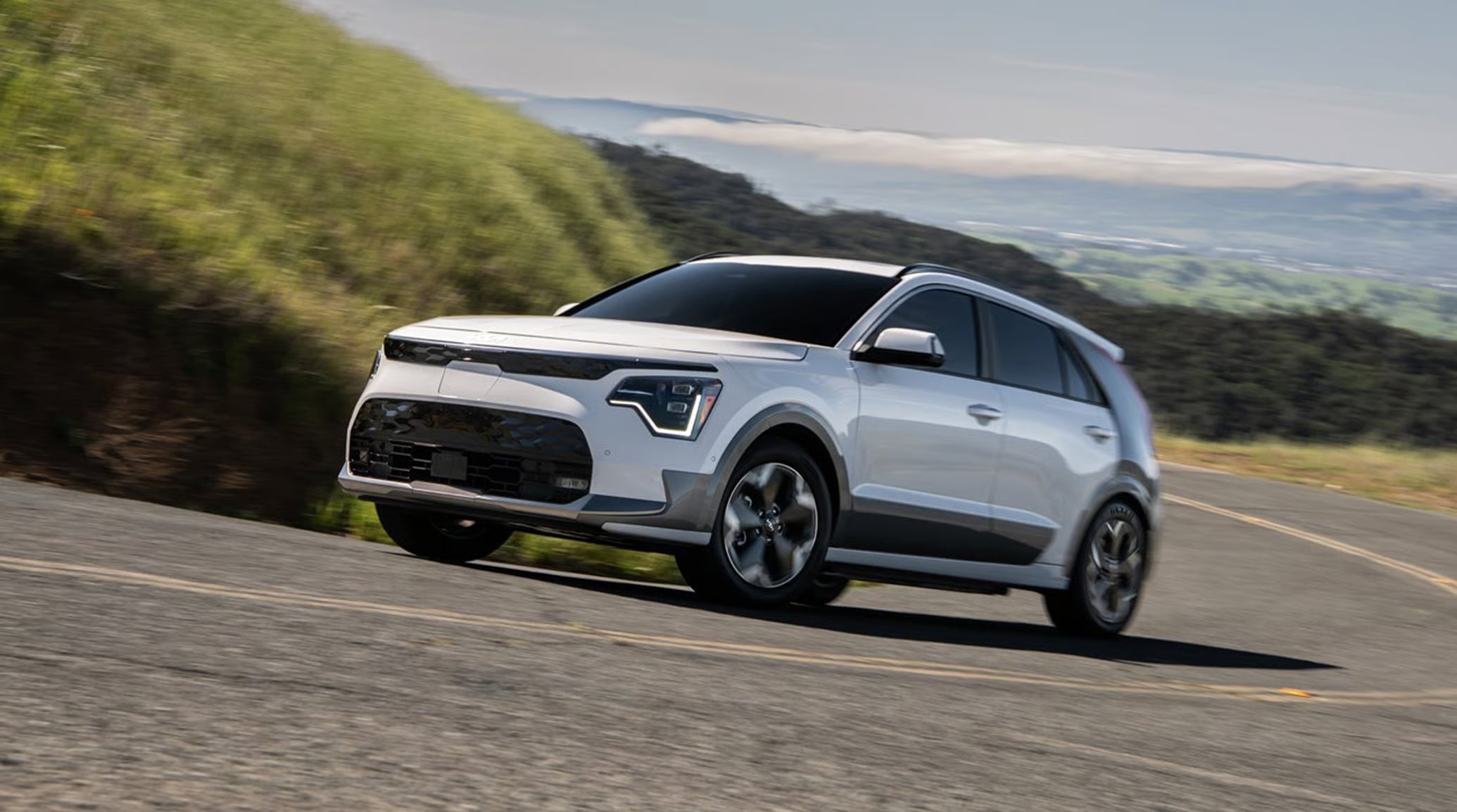
Kia Ends Production of the Niro EV
Kia has confirmed that the Niro EV, once positioned as the company’s most accessible electric crossover, is no longer being produced. The decision marks the end of a model that helped introduce many drivers to electric mobility during the early stages of the EV market’s expansion.
According to statements reported by The Korea Herald, company representatives indicated that manufacturing of the electric Niro has stopped. Jung Yoon-kyung, a senior marketing manager at Kia, explained that the electric variant had been produced through the previous model cycle but would not continue into the updated version.
Instead of building new units, the automaker plans to sell through remaining inventory currently available at dealerships. Once those vehicles are gone, the Niro EV will effectively disappear from Kia’s global product lineup.

Refreshed Niro Moves Forward as a Hybrid Only
Earlier this year, Kia introduced an updated version of the Niro crossover. At the time, the company did not clarify which powertrain options would be offered with the refreshed design.
Recent announcements now make that strategy clearer. The latest Niro will continue in hybrid form, while the fully electric and plug-in hybrid versions are being discontinued.
In South Korea, the revised model will be offered with a 1.6-liter gasoline engine paired with an electric motor, producing a combined output of 141 horsepower. The electric component contributes 43 horsepower within that system.
It remains uncertain whether the facelifted hybrid-only Niro will be sold in the United States, as Kia has not yet confirmed plans for that market.
A Pioneer in the Early Affordable EV Segment
When the first-generation Niro EV debuted in 2018, it arrived during a period when relatively affordable electric vehicles were still uncommon. At the time, the model helped broaden consumer awareness of battery-powered crossovers.
Kia introduced a second generation in 2021, bringing a redesigned exterior and several technical improvements. Among those updates was an increase in DC fast-charging capability, which reduced charging times compared with the earlier model.
Despite these improvements, the Niro EV gradually became a difficult product to position within Kia’s broader electric vehicle strategy.
Competition Intensified in the Entry-Level EV Market
Part of the challenge came from changes in the broader EV market. When the Niro EV first launched, the number of relatively affordable electric vehicles was limited. Over time, however, several new competitors emerged.
In the United States, the Niro EV carried a starting price close to $40,000, offering an estimated 253 miles of driving range. While those figures were once competitive, newer models began offering more range or lower prices.
For example, the Tesla Model 3—a larger sedan—starts at around $36,990 while delivering approximately 321 miles of range. Other models such as the Chevrolet Bolt EV, priced under $30,000, and the Nissan Leaf, which also starts near $30,000, further increased pressure in the entry-level EV segment.
As more options became available, the Niro EV’s value proposition became harder to justify compared with newer alternatives.
New Kia EV Models Shift the Strategy
Another factor influencing Kia’s decision was the introduction of newer electric vehicles built on more advanced platforms.
The company recently unveiled the EV3 and EV4, two upcoming models designed with next-generation EV architecture. These vehicles are expected to offer lower prices and updated technology, making them more competitive in the evolving market.
Because these newer models occupy a similar size and price category as the Niro EV, maintaining both products simultaneously may have created unnecessary overlap.
By discontinuing the electric Niro, Kia can focus its resources on vehicles that better align with its long-term electrification strategy.
Impact on Kia’s EV Lineup in the United States
The phase-out of the Niro EV also reshapes Kia’s electric vehicle portfolio in the United States.
Once existing inventory is sold, the company’s EV lineup in the American market will effectively be limited to two models: the EV6 crossover and the EV9 three-row SUV.
Both vehicles are already established products, but they target different price segments than the Niro EV did. The EV6 sits in the mid-range of the EV market, while the EV9 occupies a larger and more premium category.
Trade and Production Factors Affect Model Availability
International trade conditions have also played a role in determining which vehicles Kia offers in the United States.
Some electric models were originally planned for import but have faced complications due to tariff policies and geopolitical tensions affecting global trade. These factors have made it more difficult for the company to introduce certain EVs in the American market.
For instance, the high-performance EV6 GT is manufactured in South Korea, and the changing tariff environment recently led Kia to pause its U.S. sales.
Meanwhile, the EV9 and standard versions of the EV6 are assembled in the United States. Domestic production allows these models to avoid potential import-related cost increases, making them less vulnerable to shifting trade policies.

End of an Important Early EV Model
Although the Niro EV is leaving production, its role in the evolution of Kia’s electric lineup remains significant.
The vehicle helped the company establish a presence in the growing EV market and demonstrated that electric crossovers could be practical daily drivers. Over time, however, the rapid pace of technological development and increasing competition reshaped the segment.
With newer platforms and models on the way, Kia appears to be consolidating its EV strategy around vehicles that better match the next phase of electric vehicle development.
Recommend Reading: Why Kia’s EV Sales Are Slowing in the U.S.









Share:
Gas Price Spike Drives More Americans to Research EVs
Honda Ends 0 Series EV Program and Cancels Acura RSX Electric