





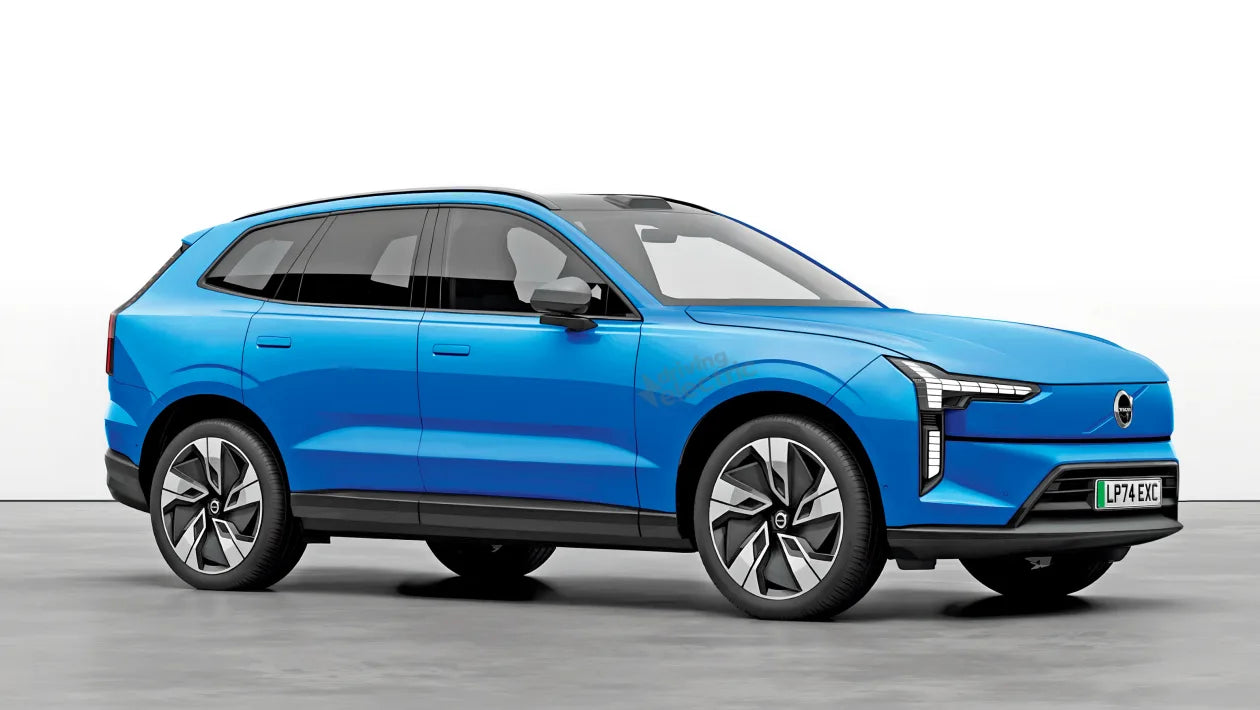
After a turbulent period marked by software delays and unfinished features, Volvo is resetting its electric vehicle strategy with a model it considers critical to its future. The upcoming Volvo EX60 is designed not only to restore confidence in the brand’s EV roadmap, but also to compete directly with the longest-range electric crossovers currently on the market.
Scheduled for its official debut on January 21, the EX60 represents Volvo’s most ambitious electric launch to date and one of the most strategically important vehicles since the second-generation XC60 became the brand’s global sales backbone.

A Key Model in Volvo’s Electric Reset
The EX60 arrives at a pivotal moment for Volvo. Earlier EV launches, including the EX90 and EX30, struggled with software instability and delayed features that frustrated early adopters. With the EX60, Volvo aims to demonstrate that it can deliver a mature, performance-focused EV without repeating those mistakes.
Positioned as a midsize electric crossover, the EX60 is intended to be a do-it-all vehicle, balancing range, charging speed, practicality, and efficiency. In today’s EV market, that balance starts with driving distance and charging performance—areas where Volvo is making bold claims.
Class-Leading Range Claims
Volvo says the EX60 will offer an estimated 400 miles of driving range, calculated using EPA testing procedures, though official certification is still pending. For European markets, the company is projecting a WLTP range of up to 810 kilometers.
What makes the claim more notable is that this figure applies to the all-wheel drive version, a configuration that typically sacrifices efficiency for traction. Volvo states that the EX60 delivers the longest range of any electric vehicle it has ever produced.
By comparison, the longest-range Tesla Model Y currently offers 357 miles of EPA-rated range, while upcoming electric rivals from BMW and Mercedes-Benz are expected to reach similar territory only in select configurations.
800-Volt Architecture and Faster Charging
The EX60 is built on Volvo’s new SPA3 electric architecture, which operates on an 800-volt system. This allows the vehicle to take advantage of high-power DC fast charging.
According to Volvo, the EX60 can add up to 168 miles of range in just 10 minutes when connected to a 400-kilowatt charger. The company also claims that approximately 100 miles of range can be added in only a few minutes under optimal conditions.
These figures place the EX60 among the fastest-charging electric crossovers expected to enter the market, addressing one of the key concerns for EV buyers who rely on public charging.
Manufacturing Advances and Efficiency Gains
Volvo credits much of the EX60’s performance to changes in how the vehicle is built. The company is adopting gigacasting techniques, a manufacturing approach popularized by Tesla and BYD, which reduces part counts and overall vehicle weight.
In addition, Volvo says the EX60 features in-house-developed electric motors, allowing tighter integration and improved efficiency. Lightweight materials are used throughout the body structure to further enhance range without increasing battery size unnecessarily.
Battery Strategy and Long-Term Ownership Focus
While Volvo has not disclosed the EX60’s battery capacity, it has confirmed that every model will come with a 10-year battery warranty, underscoring a focus on long-term durability.
Industry observers expect multiple battery configurations, potentially including a lithium iron phosphate (LFP) option. While LFP batteries typically offer lower energy density, they are known for longevity, thermal stability, and reduced degradation—qualities that align with Volvo’s emphasis on reliability.
A Practical Interior With Possible Three-Row Seating
Early images released by Volvo suggest that the EX60 may offer optional third-row seating, a rare feature in compact and midsize electric crossovers. Photos show foldable rear seats and a deep cargo area reminiscent of layouts found in larger SUVs.
If confirmed, this would place the EX60 among a very small group of three-row electric crossovers in the U.S., with limited competition and no direct equivalent from Tesla, whose Model Y has remained a five-seat vehicle in recent years.

Setting Expectations Ahead of the Official Reveal
More technical specifications and interior details will be revealed later this month. However, based on early information, the EX60 appears positioned to serve as a turning point for Volvo’s electric ambitions.
If Volvo can deliver on its range, charging, and reliability promises, the EX60 could emerge as a serious contender in the increasingly competitive electric SUV market.
Recommend Reading: Volvo EV Sales Show Sharp Regional Divide in 2025


Share:
New York Plans East Coast’s Largest Battery-Powered EV Charging Hub
Tesla’s Cybercab Could Get Regulatory Boost From Congress