

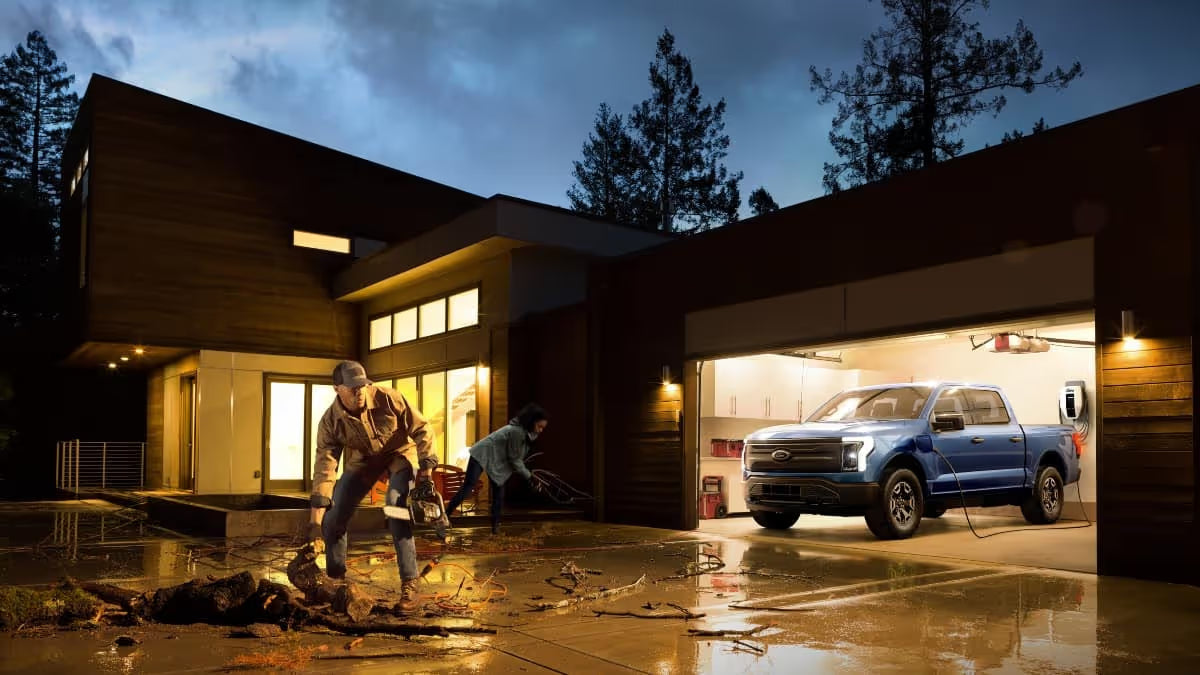
The Ford F-150 Lightning may be nearing the end of its production run, but its real-world impact is difficult to ignore. Far beyond being just an electric pickup, the Lightning proved itself as a mobile power source during disasters, outages, and medical emergencies—often when nothing else could help.

From hurricane-stricken clinics to flooded towns and stranded individuals, the Lightning’s large battery and bidirectional charging capabilities turned it into a critical tool in moments that mattered most.

How the Ford F-150 Lightning Became an Emergency Power Lifeline


Real Emergencies, Real Power

Across the U.S., owners repeatedly relied on the Lightning when grid power failed. In Florida, an emergency veterinary clinic lost electricity after a hurricane. Instead of shutting down, the clinic stayed operational thanks to a Lightning parked outside, supplying power directly to medical equipment.

In California, an elderly man whose electric wheelchair ran out of battery regained mobility after a Lightning powered it back up. During the Kentucky floods of 2022, Ford itself deployed multiple Lightnings as mobile generators to support cleanup efforts.

These stories share a common thread: when traditional infrastructure failed, the truck’s high-voltage battery—ranging from 96 kWh to 131 kWh depending on trim—became a lifeline.


A Clinic Saved by an Electric Truck

Few examples illustrate this better than Dr. Erica Lacher’s experience in Florida. When a major storm knocked out power at her emergency veterinary clinic, she used her Lightning to restore electricity within minutes.

By connecting the truck’s onboard power outlet to the clinic’s generator transfer switch, surgical equipment and critical systems were back online almost immediately.

“It definitely saved lives,” Lacher said, describing the Lightning as both a dependable daily driver and a reliable backup generator. For her, concerns about EV range faded quickly once she saw the truck perform under pressure.


Ahead of Its Time on Bidirectional Power

Long before bidirectional charging became a mainstream EV talking point, the Lightning already supported vehicle-to-load (V2L) and vehicle-to-home (V2H) functionality. This allowed owners to power appliances, homes, and small businesses directly from the truck’s battery.

While newer EVs are beginning to adopt similar features, the Lightning stood out for how seamlessly it integrated exportable power into a mass-market vehicle—especially one as familiar as an F-150.

Owners frequently describe running refrigerators, medical devices, lighting, and even sharing power with neighbors during prolonged outages.


Loyal Owners, Abrupt Ending

Despite its capabilities, Ford recently confirmed it would end production of the F-150 Lightning and cancel plans for the next-generation all-electric “T3” pickup. Instead, the company will pivot toward an extended-range electric vehicle (EREV) version of the Lightning, pairing a gas generator with an electric drivetrain.

Ford cited market conditions, changing consumer preferences, and regulatory shifts as reasons for the decision. The loss of federal EV incentives and revised fuel economy rules have made fully electric trucks harder to justify financially.


Sales Reality and Strategic Pressure

While the Lightning briefly became the best-selling electric pickup in the U.S., its sales paled in comparison to Ford’s gas and hybrid trucks. In 2024, the F-150 hybrid sold nearly 74,000 units, more than double the Lightning’s 33,150.

At the same time, Ford’s EV division continues to operate at a loss. Continuing Lightning production would have meant ongoing financial strain, prompting Ford to refocus on its profitable gas trucks and future lower-cost EVs built on its Universal EV Platform.

How the Ford F-150 Lightning Became an Emergency Power Lifeline


Owner Pushback and Unanswered Questions

Many Lightning owners are unhappy with the shift. Some had been waiting for the canceled T3, hoping for faster charging, longer range, and improved software. Others worry that an EREV undermines one of the Lightning’s biggest advantages: low maintenance and full electrification.

While Ford promises the upcoming EREV will retain exportable power and improve towing range, skepticism remains. For owners who already relied on the Lightning as a dependable electric tool, Ford’s next step feels uncertain.

Recommend Reading: Ford Scales Back EV Ambitions at a Cost of Nearly $20 Billion

Hinterlassen Sie einen Kommentar

Bitte beachte, dass Kommentare vor der Veröffentlichung freigegeben werden müssen.

Diese Website ist durch hCaptcha geschützt und es gelten die allgemeinen Geschäftsbedingungen und Datenschutzbestimmungen von hCaptcha.

FAQs – Chinesische Elektrofahrzeuge für US-Elektrofahrzeugnutzer

Was ist Ford BlueCruise und wie funktioniert es?

Ford BlueCruise ist die freihändige Fahrtechnologie von Ford, die auf ausgewählten Autobahnen in Nordamerika, den sogenannten Blue Zones , verfügbar ist. Sie nutzt eine Kombination aus adaptiver Geschwindigkeitsregelung, Spurzentrierung, GPS-Kartierung und auf den Fahrer gerichteten Kameras, um freihändiges Fahren zu ermöglichen und gleichzeitig sicherzustellen, dass der Fahrer aufmerksam bleibt.

Welche Ford- und Lincoln-Fahrzeuge sind mit BlueCruise ausgestattet?

Ab 2025 ist BlueCruise für beliebte Modelle wie den Ford Mustang Mach-E, F-150 Lightning, F-150, Expedition sowie Lincoln Navigator, Aviator und Corsair verfügbar. Ford plant, die Verfügbarkeit von BlueCruise in den kommenden Jahren auf weitere Elektro- und konventionelle Fahrzeuge auszuweiten.

Wie viel kostet Ford BlueCruise?

BlueCruise bietet in der Regel eine Testphase (90 Tage bis 3 Jahre, je nach Modell) und erfordert anschließend ein Abonnement. Die Preise beginnen bei etwa 800 US-Dollar pro Jahr oder 75 US-Dollar pro Monat , wobei die Pakete je nach Fahrzeug und Händlerangeboten variieren.

Was sind Ford BlueCruise Blue Zones?

Blue Zones sind vorkartierte, geteilte Autobahnen, auf denen BlueCruise für freihändiges Fahren validiert wurde. Ab 2025 decken Blue Zones über 200.000 Meilen Autobahnen in den USA und Kanada ab, wobei Ford die Abdeckung durch drahtlose Updates erweitert.

Ist Ford BlueCruise dasselbe wie Tesla Autopilot oder GM Super Cruise?

Nein. Obwohl es sich bei allen um Fahrerassistenzsysteme (ADAS) handelt, funktioniert jedes anders. Tesla Autopilot basiert auf kamerabasierter KI , GM Super Cruise nutzt LiDAR-basierte HD-Karten und Ford BlueCruise kombiniert adaptive Geschwindigkeitsregelung, Spurzentrierung und Fahrerüberwachung . BlueCruise ist eher für praktisches und sicheres Fahren auf der Autobahn als für völlig autonomes Fahren konzipiert.

Funktioniert Ford BlueCruise bei schlechtem Wetter oder starkem Verkehr?

BlueCruise funktioniert bei Regen, Nebel und Stop-and-Go-Verkehr . Bei extremen Wetterbedingungen wie Schneestürmen oder wenn die Fahrbahnmarkierungen nicht sichtbar sind, kann die Leistung jedoch eingeschränkt sein. Das System erfordert stets die Aufmerksamkeit und Übernahmebereitschaft des Fahrers.

Kann Ford BlueCruise mit neuen Funktionen aktualisiert werden?

Ja. BlueCruise ist mit Over-the-Air-Updates (OTA) ausgestattet. Das bedeutet, dass Ford neue Funktionen veröffentlichen, Blue Zones erweitern und die Systemleistung verbessern kann, ohne dass ein Besuch beim Händler erforderlich ist. Das macht BlueCruise im Vergleich zu herkömmlichen ADAS-Systemen zukunftssicher .

Macht Ford BlueCruise ein Fahrzeug vollständig selbstfahrend?

Nein. Ford BlueCruise ist gemäß SAE-Standards als autonomes Fahrsystem der Stufe 2 eingestuft. Das bedeutet, dass es unter bestimmten Bedingungen die Freisprechfunktion bietet, der Fahrer jedoch stets aufmerksam bleiben und die Straße im Auge behalten muss.

Welche Sicherheitsmerkmale bietet Ford BlueCruise?

BlueCruise nutzt Infrarotkameras, die auf den Fahrer gerichtet sind und dafür sorgen, dass der Blick des Fahrers auf der Straße bleibt. Schaut der Fahrer zu lange weg, gibt das System Warnungen aus und bremst das Fahrzeug schrittweise ab, wenn keine Reaktion erkannt wird. Das macht es sicherer als Systeme, die die Unaufmerksamkeit des Fahrers zulassen.

Wie sieht die Zukunft der Ford BlueCruise-Technologie aus?

Ford plant, BlueCruise weiter auszubauen. Dazu gehören mehr kartierte Straßen, eine verbesserte Spurwechselautomatisierung und die Integration mit Elektrofahrzeugplattformen wie dem Mustang Mach-E und dem F-150 Lightning. Bis 2030 will Ford BlueCruise zu einem Eckpfeiler seines vernetzten Fahrzeug-Ökosystems machen und damit direkt mit Tesla FSD und GM Super Cruise konkurrieren.

EV-Neuigkeiten

Alle anzeigen

EV Buyers May See Deeper Discounts as Unsold 2024–2025 Models Pile Up

EV Buyers May See Deeper Discounts as Unsold 2024–2025 Models Pile Up

As dealers enter 2026 with large stocks of unsold 2024 and 2025 electric vehicles, buyers may benefit from deeper discounts and better negotiating power, particularly on premium EVs with slower sales.

Weiterlesen

U.S. Electric Vehicle Sales Set to Decline in 2025 After Years of Growth

U.S. Electric Vehicle Sales Set to Decline in 2025 After Years of Growth

U.S. electric vehicle sales are projected to decline in 2025 after years of rapid growth, driven by the loss of tax credits, policy reversals, and automakers canceling underperforming EV models.

Weiterlesen

Volkswagen ID. Polo Prototype Shows a Clear Shift in VW’s EV Strategy

Volkswagen ID. Polo Prototype Shows a Clear Shift in VW’s EV Strategy

The Volkswagen ID. Polo prototype highlights a major shift in VW’s EV strategy, prioritizing affordability, interior space, and familiar design over experimentation, as the brand targets mainstream small-car buyers.

Weiterlesen