



Affordable EVs Gain Momentum in the U.S. Market
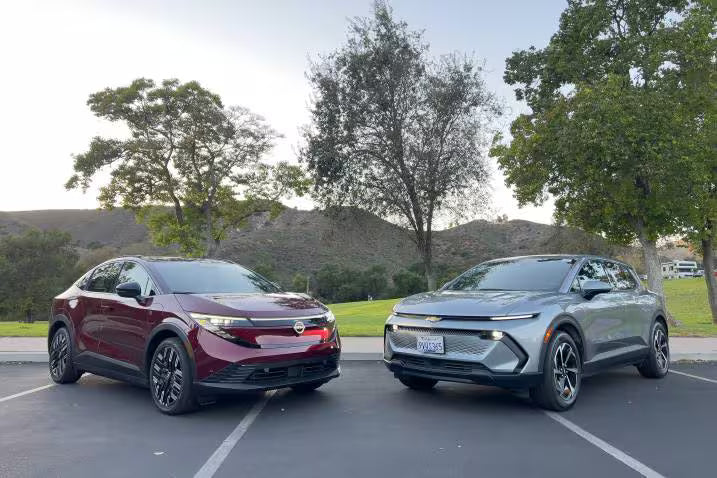
Electric vehicles in the United States are becoming more accessible as technology advances and battery prices trend downward. The latest examples leading this shift are the Chevrolet Equinox EV and the new Nissan Leaf, two models positioned as practical, long-range EVs priced below or around the $35,000–$40,000 range.
Both vehicles promise over 300 miles of range, competitive charging performance, and the kind of standard tech features that were once limited to premium models. But choosing the stronger option requires a deeper look at their strengths, weaknesses, and real-world value.

Shared Foundations: Range, Charging, and Software
The two EVs overlap significantly in key performance areas. The Chevy Equinox EV, winner of a 2024 Breakthrough Award, features an 85-kWh battery rated for up to 319 miles depending on the trim. It supports 150-kW DC fast charging, allowing a 10%–80% charge in roughly 35–40 minutes under ideal conditions. Pricing begins at $33,600 before fees and incentives.
The all-new Nissan Leaf, redesigned and no longer related to the previous-generation budget model, includes a 75-kWh battery and delivers up to 303 miles of range. Its fast-charging specifications mirror the Equinox EV, topping out at 150 kW with an estimated 35-minute 10%–80% session.
Both vehicles also use an Android Automotive OS base with Google Built-In, offering strong voice control and native Google Maps. However, their tech ecosystems differ in one important area: the Leaf retains Apple CarPlay and Android Auto, while GM’s EV lineup—including the Equinox EV—does not support smartphone mirroring.
Key Differences: Drivetrain, Charging Ports, and Usability
Where the Equinox EV stands out is configurability. It offers front-wheel drive or all-wheel drive, while the Leaf remains strictly FWD. This distinction may matter for buyers in snowy or rural regions.
The Leaf takes a unique turn with charging hardware by offering a NACS fast-charging connector paired with the traditional J1772 for Level 2 charging. The mixed-port setup is unusual but fully functional, and it positions the Leaf to take advantage of rapidly expanding Tesla Supercharger access.
GM attempts to counter with software perks: the Equinox EV includes an eight-year Google services subscription, while the Leaf provides just one year of access.
Pricing in Practice: What Buyers Actually Get
On paper, the Leaf’s $29,990 base price is appealing, but low-spec versions may be challenging to find. Mid-tier trims reflect more realistic transaction prices. Reviewers and analysts highlight the Leaf SV Plus, starting at $34,230, as the best value. It includes meaningful upgrades such as:
-
Improved upholstery and premium audio
-
Larger infotainment display with Google integration
-
Rear-seat USB ports and air vents
-
A heat pump for better winter efficiency
Fully equipped, the Leaf tested by reviewers landed just above $40,000.
The Equinox EV, meanwhile, ranges from the mid-$30,000s to nearly $50,000 depending on options. But in mid-range trims, reviewers consistently find the Chevy offers more interior space, better ride quality, and greater versatility, contributing to its broad appeal.

Which Model Delivers Better Overall Value?
For shoppers seeking maximum versatility and interior room, the Chevy Equinox EV remains the more complete package. Its broader drivetrain options, longer range potential, and extended software support give it a slight edge.
However, the new Nissan Leaf shines in key areas: smartphone integration, winter-friendly efficiency, and competitive pricing when equipped thoughtfully. Some drivers may prefer its smaller footprint and simpler configuration.
Ultimately, both models mark a significant step forward for affordable American EV choices. The best approach is to test-drive each, compare real-world pricing, and choose the model that aligns with your daily driving needs. The good news: neither option is a misstep as the U.S. EV market enters 2026 with stronger value than ever.
Recommend Reading: Chevy Bolt vs. Nissan Leaf: Battle of America’s Cheapest EVs



Share:
Kia EV6 and Hyundai Ioniq 9 to Soon Support Full Home Power Backup
BYD Prepares Global Rollout of Ultra-Fast 5-Minute EV Charging