





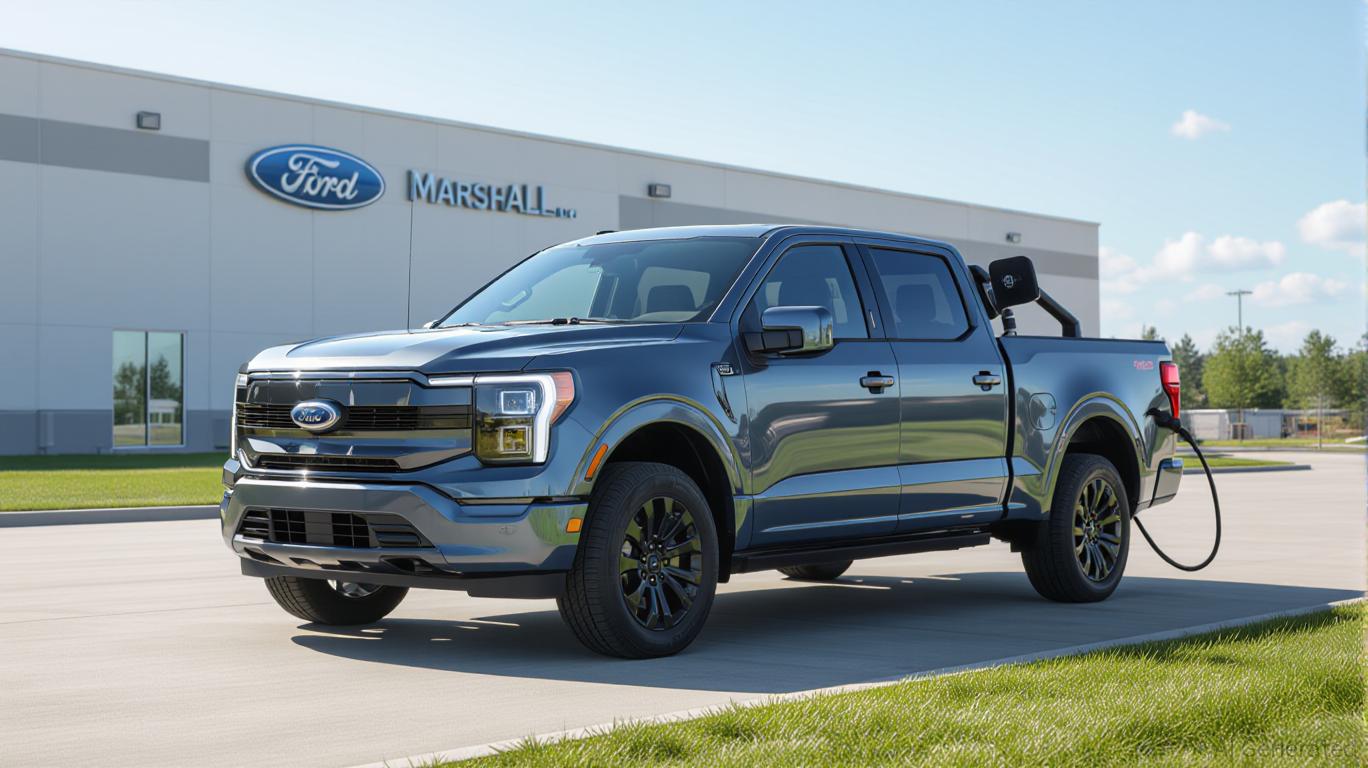
Ford is preparing a new foundation for its next generation of battery-powered vehicles, aiming to correct earlier missteps in the electric pickup space. The initiative centers on a fresh architecture scheduled to debut in 2027, beginning with a midsize truck projected to cost about $30,000. Company leaders say the program reflects a broader shift in engineering priorities, cost control, and software strategy.

Why Ford Is Rethinking Its EV Strategy
Ford’s first wave of electric products delivered mixed outcomes. The F-150 Lightning generated strong initial interest but faced scrutiny over pricing, towing limitations, and profitability challenges. Meanwhile, the Mustang Mach-E achieved solid sales volumes, yet it alone cannot anchor Ford’s long-term electric ambitions—especially as executives warn of rising competition from Chinese manufacturers with aggressive pricing structures.
Rather than abandoning electrification goals, Ford is using those experiences to inform a new vehicle base known internally as the Universal Electric Vehicle (UEV) platform. The idea is to reduce complexity, lower production costs, and align vehicle design more closely with how EVs actually function, instead of adapting gasoline-era assumptions.

Launching With a Smaller, More Efficient Truck
The first product riding on the UEV structure will be a compact-to-midsize pickup. Executives describe it as roughly comparable in footprint to the Ford Maverick, a model that has proven popular among buyers seeking practicality at a manageable price.
This upcoming EV will not chase the oversized, heavy-duty segment. Instead, the focus is on everyday usability, passenger room, and cargo flexibility. Engineers prioritized aerodynamic efficiency from the earliest sketches, acknowledging that battery packs remain the single largest cost component in an electric vehicle. If battery capacity cannot be drastically reduced without harming driving range, then reducing drag becomes the logical solution.
Ford claims the new truck will be approximately 15% more aerodynamically efficient than the most streamlined pickup currently on sale. Achieving that required extensive modeling, rapid prototyping, and a willingness to revise body panels repeatedly to capture incremental gains. Even small reductions in frontal area and airflow disruption translate directly into measurable range improvements.
“The Best Part Is No Part”
A guiding principle behind the program emphasizes eliminating unnecessary components. Engineers adopted a mindset that every additional piece carries cost, weight, and complexity. For example, the side mirrors use a shared motor for folding and adjustment, cutting overall mirror size by more than 20%. Ford estimates that change alone contributes roughly 1.5 miles of extra range.
The same logic applies throughout the vehicle. Consolidated hardware, simplified assemblies, and multi-function components are meant to trim expenses without sacrificing features that customers notice. This philosophy mirrors practices seen at newer EV-focused companies, but Ford says it has adapted the approach to its own manufacturing scale.
A Software-Centered Architecture
Beyond mechanical efficiency, the UEV platform is designed as a fully software-defined vehicle. Traditional automobiles often contain dozens of electronic control units sourced from different suppliers, each operating semi-independently. Updating them can require coordination across multiple vendors.
Ford’s new structure replaces that patchwork with centralized computing and standardized communication pathways. Key systems are managed by domain controllers, including a consolidated “E-Box” that integrates power electronics and charging functions. By controlling its own software stack, Ford expects faster over-the-air updates and feature rollouts across multiple models built on the same base.
Executives argue that this shift directly supports affordability. Removing redundant wiring and hardware reduces material cost, while unified software enables scalable feature development. The UEV platform is expected to underpin as many as eight different vehicles, ensuring broader economies of scale.
Over-the-Air Updates With Broader Reach
Many legacy automakers advertise remote update capability, yet real-world deployment has often been inconsistent. Ford says its upcoming system will allow simultaneous updates across all vehicles using the new architecture, rather than staggered releases tied to individual models.
Company leaders cite prior challenges in coordinating updates between internal teams and outside suppliers. With the UEV approach, those barriers should be minimized because Ford retains full oversight of the software ecosystem. The aim is to deliver meaningful enhancements throughout the vehicle’s lifespan rather than sporadic fixes.

Battery Chemistry and Voltage Decisions
To maintain its targeted entry price, Ford selected lithium-iron phosphate (LFP) cells for this program. While these batteries generally offer lower energy density than nickel-based chemistries, they are more cost-effective, durable, and stable. Ford states that its LFP packs for the UEV will be produced domestically and positioned among the least expensive in the U.S. market.
Notably, the company chose a 400-volt electrical system instead of transitioning to the increasingly common 800-volt standard. Although higher-voltage setups can enable ultra-fast charging, Ford concluded that the additional expense did not align with its affordability goals. Executives estimate that adopting 800 volts could raise system costs by roughly 20%, undermining the platform’s pricing target.
Upgraded Electrical Backbone and Driver Assistance
While the high-voltage system remains at 400 volts, low-voltage electronics move to 48 volts, replacing the long-standing 12-volt format. This adjustment reduces wiring mass and improves efficiency, particularly for advanced driver-assistance technologies.
Ford indicates that the UEV platform is engineered to support future hands-free or even eyes-off driving capabilities, though details remain limited. The company has not confirmed sensor choices or deployment timelines, and industry-wide autonomy ambitions have faced delays. As such, these capabilities should be viewed as developmental rather than imminent.

Structural Battery Integration
The platform introduces Ford’s first structural battery concept. Though not a pure cell-to-body design, the battery pack becomes a load-bearing element of the vehicle’s floor. Interior components mount directly to this structure, eliminating redundant layers between cabin and pack.
This integration lowers roof height and enhances aerodynamic performance while preserving cabin space. By embedding the battery into the chassis, engineers reduce weight and improve rigidity—both critical factors in overall efficiency.
A System-Wide Efficiency Strategy
The most significant transformation may be organizational rather than technical. Historically, vehicle programs were divided into separate engineering silos. For the UEV initiative, Ford emphasizes cross-functional optimization. Every decision—whether aerodynamic shaping, battery chemistry, or software consolidation—serves a single objective: deliver competitive range and features at an attainable price.
If the company succeeds, the result will be a midsize electric truck combining practical capability, scalable software, and a starting price near $30,000. Production is expected to begin in 2027, with broader rollout across additional models to follow.
Recommend Reading: Ford Targets $30,000 Electric Truck with New Universal EV Platform


Share:
When Will the 2027 BMW i3 Electric 3 Series Arrive?
Volvo EX60 Orders Surge, Forcing Higher 2026 Production Plans