





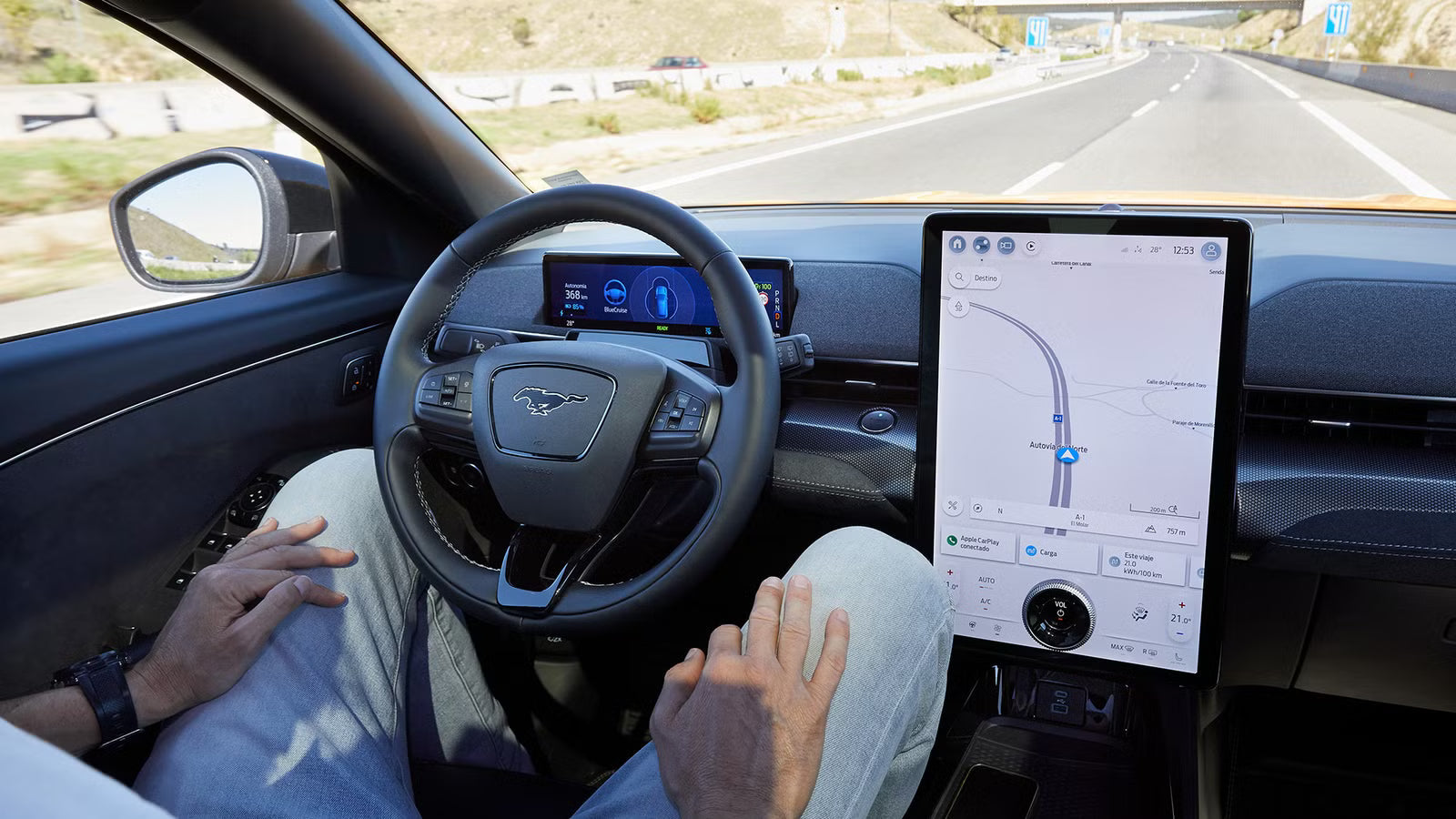
Ford is using CES 2026 to reassert its long-term technology ambitions, even as it continues to recalibrate its electric vehicle strategy in the short term. The automaker announced that eyes-off automated driving will arrive in 2028, debuting on its next-generation Universal Electric Vehicle (UEV) platform—a clean-sheet architecture designed to support a $30,000 electric pickup truck and a broader family of cost-efficient EVs.
While Ford has recently slowed EV investments amid softer demand and pricing pressure, the company is signaling that advanced software, automation, and vertical integration remain central to its future. The UEV platform is now positioned not only as a low-cost EV foundation, but also as the backbone of Ford’s next leap in driver-assistance technology.

Advancing BlueCruise Beyond Hands-Free Driving
Today, Ford’s BlueCruise system enables hands-free highway driving on more than 130,000 miles of pre-mapped roads across North America. Drivers are allowed to remove their hands from the steering wheel but must keep their eyes on the road and be prepared to take control at any time.
That will change in 2028. Ford confirmed that BlueCruise will evolve into Level 3 “eyes-off” automation, allowing drivers to disengage visual attention under specific conditions. While the company did not outline the exact operational design domain, the system will remain focused on controlled highway environments rather than dense urban streets.
Doug Field, Ford’s chief EV, digital, and design officer, framed the initiative as a philosophical shift rather than a luxury upgrade. “Autonomy shouldn’t be a premium feature,” Field said. “Eyes-off driving should be available to everyday customers, not just those buying flagship vehicles.”
This approach aligns with Ford’s broader strategy of scaling advanced technology downward, rather than reserving it for high-margin nameplates.

Level 3 Automation Remains Rare in the U.S.
Despite years of hype, Level 3 automation remains extremely limited in the U.S. market. Mercedes-Benz is currently the only automaker offering a certified Level 3 system, with its Drive Pilot feature available in select states and under tightly controlled conditions.
Other automakers are preparing similar systems. At CES 2026, Chinese automaker Geely announced its own Level 3 platform, while General Motors confirmed plans to introduce lidar-powered eyes-off driving in 2028, starting with the Cadillac Escalade IQ.
The contrast lies in positioning. The Escalade IQ recently carried a price tag of around $140,000, excluding potential lidar-related costs. Ford’s eyes-off ambitions, by contrast, are tied to vehicles that are expected to be dramatically more affordable.
Although Ford has not confirmed which UEV models beyond the $30,000 truck will support eyes-off BlueCruise, the company’s messaging strongly suggests that cost accessibility is a core design requirement, not an afterthought.

Sensor Choices and the Lidar Question
Ford declined to specify whether its eyes-off system will rely on lidar, a technology many experts consider critical for higher levels of automation. Lidar systems have become smaller and more affordable in recent years, particularly as Chinese suppliers scale production.
However, Ford emphasized flexibility within its sensor strategy. A company spokesperson noted that Ford now owns its end-to-end autonomy stack, spanning cameras, radar, and software. That vertical control allows Ford to adapt its approach as technology matures and regulatory frameworks evolve.
This contrasts with earlier industry models that relied heavily on third-party suppliers, often resulting in higher costs and slower development cycles.
Subscription Economics and Software Revenue
Ford also did not disclose pricing for next-generation BlueCruise. Currently, the system is available on models such as the Mustang Mach-E and F-150 Lightning for about $50 per month, $495 annually, or $2,495 as a one-time purchase.
Both Ford and GM have reported strong growth in hands-free driving subscriptions, reinforcing the idea that software-driven revenue will play a growing role in automaker profitability. Whether eyes-off capability will command a premium—or remain within existing pricing tiers—remains to be seen.
What is clear is that Ford views advanced driver assistance not just as a safety feature, but as a recurring revenue stream that can scale across millions of vehicles.

AI Integration That Extends Beyond the Dashboard
Automation was only one part of Ford’s CES presentation. The company also unveiled a new AI-powered assistant designed to function across vehicles and mobile devices, integrating deeply with the Ford and Lincoln apps.
Unlike generic AI chatbots, Ford’s system is trained on brand-specific vehicle data, allowing it to deliver practical, context-aware responses. One example highlighted at CES involved taking a photo of building materials at a home improvement store and asking whether they would fit in a truck bed.
By allowing the AI assistant to “travel” between phone and vehicle, Ford is aiming to make software a continuous part of ownership—not something confined to the cabin.
A New Computing Core for the UEV Platform
Underlying these software ambitions is the UEV platform’s High Performance Computer Center, an in-house-developed computing unit that consolidates infotainment, automated driving, audio, and connected services into a single system.
This zonal architecture reduces wiring complexity, lowers production costs, and enables faster over-the-air updates. More importantly, it gives Ford greater control over performance, security, and feature deployment over the life of the vehicle.
According to Field, the result should be vehicles that feel “more consistent, more reliable, and more capable year after year.” The strategy reflects Ford’s push toward deeper vertical integration as it competes with fast-moving Chinese EV manufacturers known for rapid software iteration.

Strategic Stakes for Ford’s Next Decade
Ford has released few details about the upcoming UEV electric truck, which is expected to debut next year. Additional information about autonomy features will follow closer to launch.
What is already clear is that Ford sees affordable automation as a strategic necessity, not a technological indulgence. As global competition intensifies and Chinese automakers prepare to expand aggressively, Ford is betting that cost-efficient EV platforms paired with advanced software will define its relevance in the coming decade.
Executives including Field and CEO Jim Farley have repeatedly stated that investments in autonomy, AI, and in-house computing will be critical to Ford’s long-term survival. CES 2026 underscored that message—and highlighted just how high the stakes have become.
Recommend Reading: Ford’s Hybrid Surge Masks a Difficult Year for Its EV Business


Share:
Best EV Lease Deals and Financing Offers in January 2026
Mazda CX-6e Signals a New Electric Direction for the Brand