





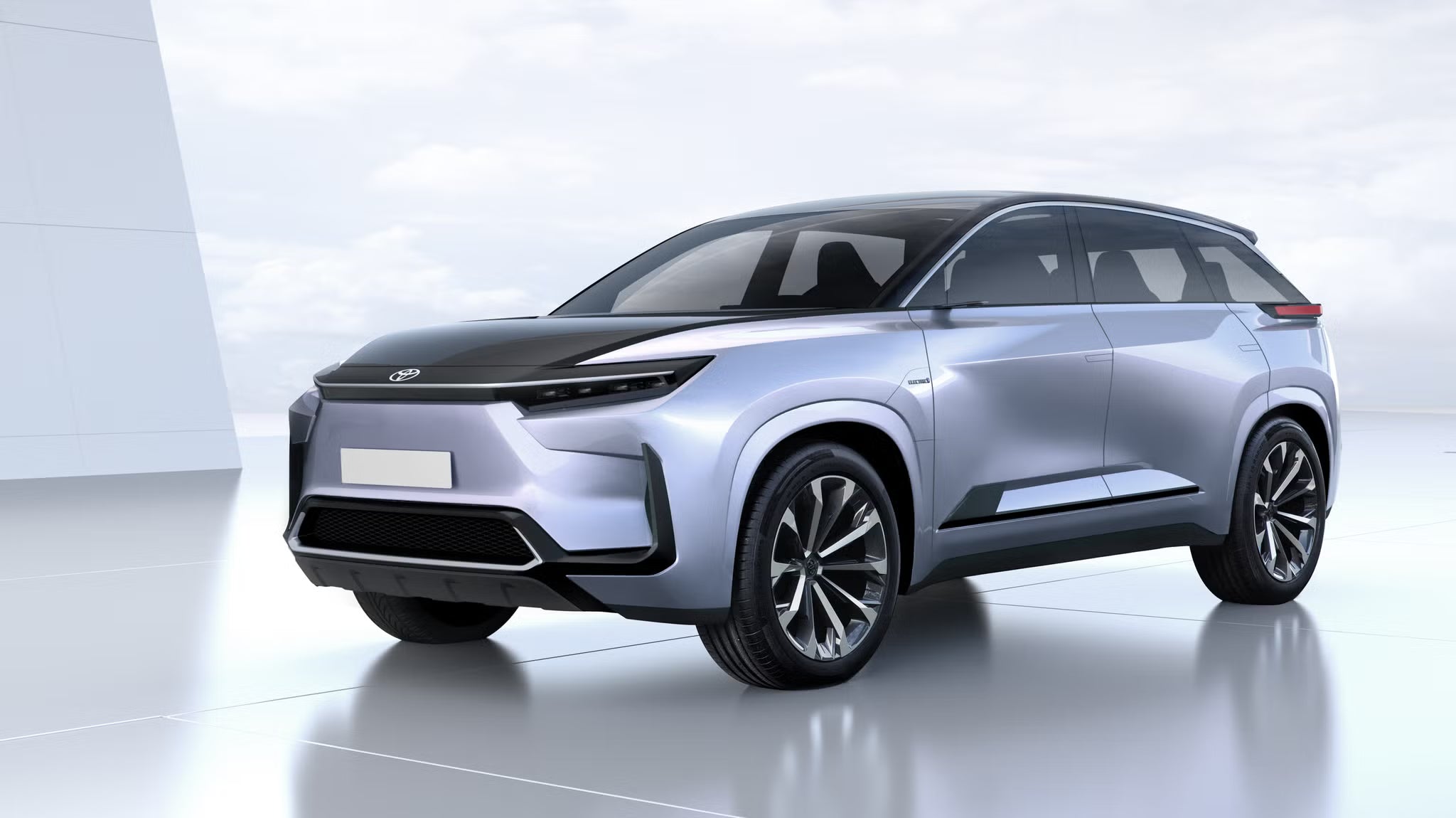
Toyota Expands Its Electric Strategy
Toyota has long emphasized hybrid technology as its primary path toward lower emissions. Its first dedicated battery-electric crossover, the bZ4X, entered the market with modest reception and reinforced the company’s cautious stance toward full electrification.
That approach is now shifting. Beginning in 2026, Toyota is refreshing its electric lineup with updated products and broader charging compatibility. The revised bZ—formerly known as the bZ4X—offers improved driving range and adopts the NACS charging connector, aligning it with Tesla’s widely used plug standard. Additional models, including the C-HR EV and the bZ Woodland, are scheduled to follow.
The most significant development, however, is the decision to electrify one of Toyota’s core nameplates. For the 2027 model year, the Highlander will debut as a fully battery-powered three-row SUV.

A New Capability: Powering Devices and Homes
Among the Highlander EV’s headline features is bidirectional charging, also referred to as vehicle-to-load (V2L) capability. This technology allows the vehicle’s battery to supply electricity to external devices.
In practical terms, owners could use the SUV’s battery pack to operate appliances during outdoor activities or emergencies. Examples include running cooking equipment while camping, powering electronics at sporting events, or keeping household essentials functioning during a blackout.
The concept is straightforward: a large traction battery represents a substantial energy reserve. Enabling external access transforms the vehicle into a mobile power source rather than limiting it solely to propulsion.
While still emerging in the broader market, this feature is gaining traction among manufacturers seeking to differentiate their EV offerings.
Battery Options and Projected Range
Toyota plans to offer the electric Highlander with two battery configurations. A standard version will use a 77-kilowatt-hour pack, while a larger 95.8 kWh battery will be available for customers seeking extended range.
According to the company, the higher-capacity variant will deliver approximately 320 miles of driving range in all-wheel-drive form. These figures position the Highlander competitively within the midsize electric SUV segment, where range expectations have steadily increased.
Additional specifications—including charging speeds and detailed performance metrics—are expected closer to launch.
How It Compares With Competitors
The Highlander EV enters a growing field of electric vehicles equipped with external power functions. Models such as the Hyundai Ioniq 9, Kia EV6, Tesla Model Y Performance, and Chevrolet Silverado EV already offer vehicle-to-load functionality in certain configurations.
However, the feature remains far from universal. Within Tesla’s lineup, for example, only the Cybertruck currently supports both V2L and vehicle-to-home (V2H) capability. The Model 3 lacks the function entirely, and earlier versions of the Model S and Model X did not provide it. Most variants of the Model Y also omit the feature.
Against that backdrop, Toyota’s inclusion of bidirectional charging on a mainstream family SUV places it ahead of several established competitors in this specific area.
Growing Relevance During Extreme Weather
Recent severe weather events across the United States have highlighted the value of backup energy sources. Prolonged power outages caused by storms, wildfires, and heatwaves have increased interest in solutions that provide temporary electricity without relying on portable generators.
Bidirectional EV systems can serve as part of a broader home energy strategy. Some automakers are already expanding into residential energy products. General Motors, for instance, now markets stationary battery systems and integrated charging equipment designed to work with its electric vehicles.
Toyota has not yet detailed whether the Highlander EV will support full vehicle-to-home integration at launch, but the inclusion of V2L lays the groundwork for expanded functionality in the future.

Timing and Market Outlook
The all-electric Highlander is scheduled to arrive in dealerships toward the end of 2026 as a 2027 model. Pricing details, accessory packages, and technical specifics related to power export capabilities are expected to be announced closer to its release date.
The move signals a broader recalibration within Toyota’s electrification strategy. By combining familiar nameplates with emerging EV features, the company appears intent on appealing to both traditional customers and early adopters.
Whether the Highlander EV achieves strong sales will depend on competitive pricing, real-world efficiency, and consumer demand for three-row electric SUVs. Nevertheless, the addition of bidirectional charging underscores Toyota’s effort to integrate practical energy solutions into its next generation of battery-powered vehicles.
Recommend Reading: Toyota Confirms Electric Highlander as Its First Three-Row EV SUV










Share:
How Long Can a Tesla Model 3 Stay Warm at -35°F?
How Rivian Gained 6 Miles of Range From a Rear Wiper