





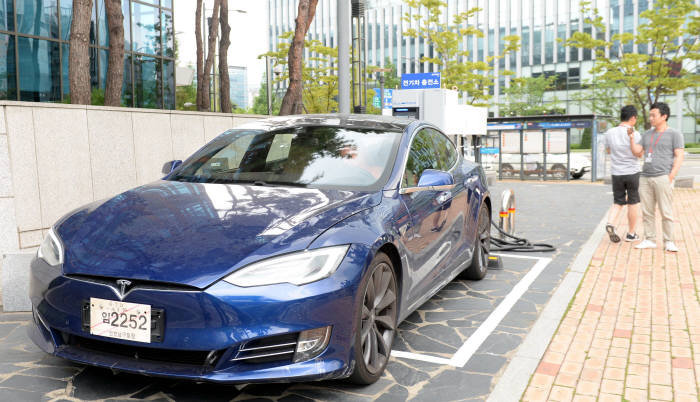
Price adjustments drive sharp increase in demand
Recent registration data from South Korea points to a significant rebound in Tesla’s local performance, following targeted price reductions on key models. In March, the company recorded 11,130 vehicle registrations, a substantial rise compared to 2,591 units in the same month a year earlier. This represents an increase of more than 330% year-over-year, highlighting how pricing strategies can rapidly influence demand.
While part of this growth may reflect a weak comparison period in the previous year, the scale of the increase suggests that lower pricing played a decisive role in attracting buyers back to Tesla’s lineup.

Dominance within the imported EV segment
Tesla’s strong monthly performance translated into a leading position among imported electric vehicles. According to industry data, total imported EV registrations reached 16,249 units in March, meaning Tesla accounted for roughly 69% of that segment.
The brand’s most popular offerings—the Model Y, Model 3 Long Range, and standard Model 3—ranked as the top three imported vehicles for the month. This concentration at the top underscores the continued appeal of Tesla’s core products, particularly when pricing aligns more closely with market expectations.
In comparison, newer entrants such as BYD remain far behind in volume. The Chinese automaker delivered 1,664 vehicles during the same period, indicating a growing but still limited presence in the Korean market.
Comparison with domestic competitors
Tesla’s March performance also appears to exceed that of local manufacturers in certain metrics. Hyundai reported 7,809 electric vehicle sales in South Korea for the same month, reflecting solid growth of 38% year-over-year. However, differences in reporting methods—registrations versus sales—make direct comparisons less precise.
Even so, the figures suggest that Tesla’s pricing adjustments allowed it to temporarily outperform domestic rivals in a market where local brands traditionally hold strong positions.
Global context: uneven but improving trends
The recovery observed in South Korea is part of a broader pattern, though not all regions show consistent growth. In Europe, Tesla registrations increased sharply in several key markets during March. Germany saw a rise of over 315%, while France recorded gains exceeding 200%, reaching 9,569 units.
Additional markets such as Norway, Sweden, Denmark, and Belgium also posted notable increases, ranging from 89% to 178%. These figures indicate renewed momentum in certain regions, even without widespread price reductions.
However, the overall global picture remains mixed. Some countries, including the Netherlands and Switzerland, continue to report declining figures, suggesting that regional dynamics and local conditions still play a major role in shaping demand.
Price sensitivity in the EV market
The strong reaction in South Korea highlights a key characteristic of today’s electric vehicle market: consumer demand is highly responsive to pricing changes. Even modest adjustments can trigger significant shifts in purchasing behavior, particularly in competitive segments.
Lower prices not only attract new buyers but can also intensify competition among manufacturers. In Korea, Tesla’s move has reportedly prompted rival brands to reassess their own pricing strategies, contributing to a more dynamic and potentially volatile market environment.
Balancing affordability and profitability
While reducing prices can boost sales volume, it also introduces challenges for automakers. Lower margins may impact profitability, especially in a sector where development and production costs remain high.
Tesla’s ability to adjust pricing may be supported by its scale of production and integrated software-focused approach, which can help reduce costs compared to traditional manufacturing models. This provides some flexibility to respond to market conditions without sacrificing core features.
For other manufacturers, achieving similar cost reductions while maintaining competitiveness presents a more complex challenge. Offering affordable vehicles without compromising range, performance, or technology remains a key hurdle across the industry.
Implications for future EV adoption
The latest data suggests that affordability remains one of the most influential factors in electric vehicle adoption. While technological advancements—such as improved software systems and dedicated EV platforms—continue to shape the market, pricing appears to have a more immediate impact on purchasing decisions.
As competition intensifies, manufacturers may increasingly focus on cost optimization alongside innovation. Those able to deliver well-equipped electric vehicles at accessible price points are likely to gain an advantage in expanding their customer base.

Conclusion
Tesla’s recent surge in South Korea demonstrates how strategic pricing can quickly reshape market performance. With registrations rising sharply after price reductions, the data reinforces the importance of affordability in driving EV adoption.
At the same time, the broader global landscape remains uneven, with growth in some regions offset by declines in others. As the industry evolves, balancing competitive pricing with sustainable business models will be essential for long-term success.
Recommend Reading: Tesla Q1 2026 Deliveries Miss Forecast Despite Growth











Share:
Kia EV3 Range Explained: How a Boxy EV Reaches 320 Miles
Tesla Regains Global EV Lead as BYD Sales Decline in Q1