





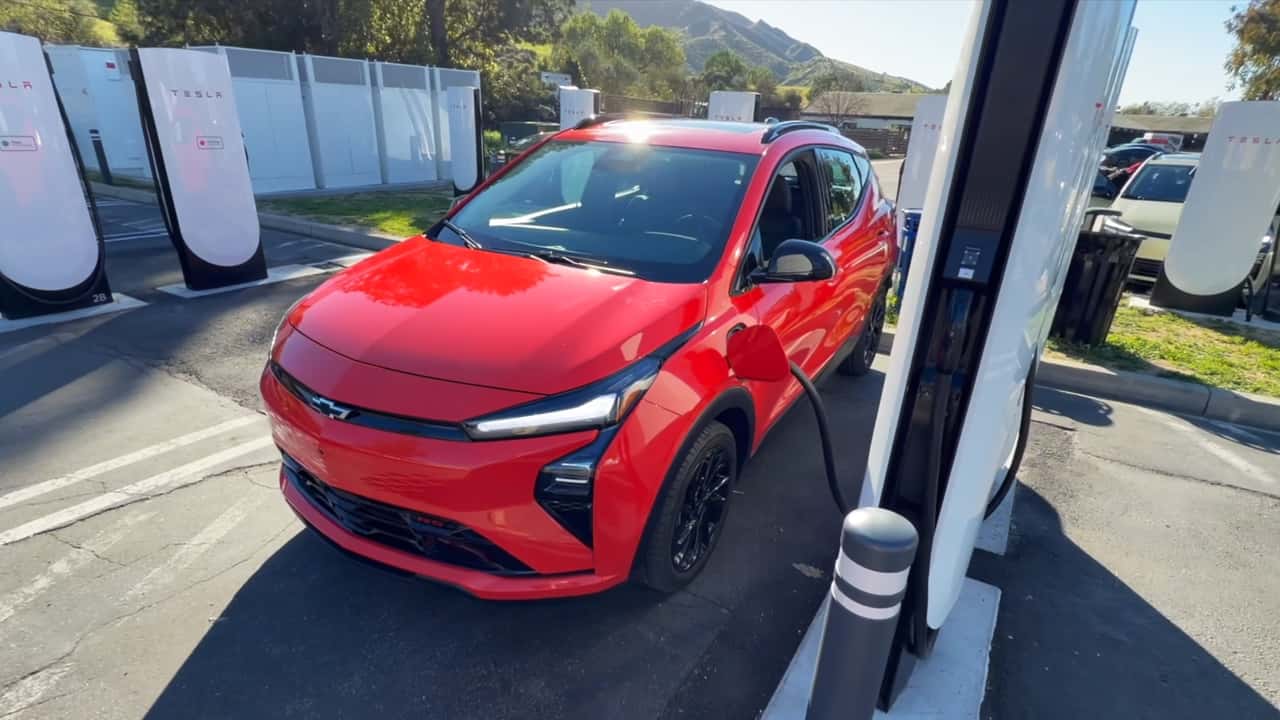
A Surprising Charging Leader in GM’s Lineup
Among the latest electric vehicles from General Motors, one model stands out for an unexpected reason: charging speed. The newest Chevrolet Bolt can replenish its battery from 10% to 80% in roughly 26 minutes, outperforming several larger and more expensive electric models produced by the same company.
That result may seem counterintuitive at first. GM’s broader electric lineup—including vehicles such as the GMC Hummer EV and the Chevrolet Equinox EV—is built around the company’s Ultium platform, which was designed to standardize battery technology across many models.
However, the Bolt takes a different technical approach, and that decision appears to be the reason behind its quicker charging performance.

How GM’s Modular Battery System Works
To manage costs while expanding its EV lineup, GM created a modular battery architecture within the Ultium platform. Instead of designing a unique battery for each vehicle, the company uses a common building block.
At the center of the design is a 103-amp-hour battery cell arranged into modules containing 24 cells. Each module produces approximately 29 volts. By combining different numbers of these modules, GM can build battery packs of varying capacities while keeping the core components consistent.
For example:
-
The Chevrolet Equinox EV, Blazer EV LT, and Cadillac Optiq use packs with 10 modules, delivering about 85 kWh.
-
Vehicles like the Cadillac Lyriq and Blazer EV SS receive 12 modules, providing roughly 102 kWh.
-
Larger vehicles, including the Chevrolet Silverado EV, use up to 24 modules, producing about 205 kWh of capacity.
This modular system simplifies manufacturing and allows the company to scale production across different vehicle types.
The Hidden Drawback: Lower Pack Voltage
While the modular strategy offers cost and production advantages, it introduces an important limitation related to battery voltage.
Individual battery cells typically operate at around 3.6 to 4.2 volts. To reach the higher voltages used in modern EVs, manufacturers connect many cells in series. The final voltage of the pack depends heavily on how those modules are configured.
In some GM vehicles using the 10-module arrangement, the overall pack voltage sits at roughly 290 volts. That relatively low voltage affects charging performance.
Charging power is calculated by multiplying voltage by electrical current. If voltage is lower, the system must rely on higher current to achieve the same charging power. For instance, reaching 150 kW at around 290 volts requires more than 500 amps of current.
Many charging stations are not optimized to deliver such high amperage at lower voltages. As a result, vehicles with these battery configurations often require access to higher-rated 250 kW or 350 kW chargers just to approach their peak charging capability.
Even in ideal conditions, charging from 10% to 80% in these vehicles can take around 40 minutes.
Larger Batteries Don’t Always Charge Faster
Some models within GM’s lineup can technically reach higher peak charging rates. For example, the Silverado EV can accept charging power of up to 350 kW under the right conditions.
However, these vehicles also carry extremely large battery packs. When total capacity exceeds 200 kWh, replenishing the battery still requires substantial time even at high power levels.
In practical terms, this means that smaller vehicles with efficient charging curves can sometimes refill faster during a road trip—even if their peak power rating is lower.
The Bolt Takes a Different Approach
The new Bolt diverges from the typical Ultium battery configuration. While it still integrates with GM’s broader EV architecture and software systems, the vehicle uses a different battery chemistry and design.
Instead of nickel-manganese-cobalt (NMC) cells, the Bolt features a lithium-iron-phosphate (LFP) battery pack supplied through partners in China.
LFP batteries offer several advantages:
-
Lower production costs
-
Longer cycle life
-
Improved thermal stability
Because this pack was not constrained by the Ultium modular structure, engineers were able to configure it with a nominal voltage closer to 400 volts.
Higher Voltage Improves the Charging Curve
That higher voltage plays a crucial role in charging performance. With a pack voltage approaching 400 volts, the Bolt can reach 150 kW charging power without requiring extremely high current levels.
More importantly, it can maintain elevated charging speeds for longer periods during the session. The result is a stronger charging curve—meaning the vehicle continues to accept high power deeper into the charge cycle rather than tapering off quickly.
Thanks to this behavior, the Bolt’s 26-minute 10–80% charging time places it ahead of several similarly priced electric vehicles, including base versions of models like the Ford Mustang Mach‑E and Volkswagen ID.4.

Turning a Previous Weakness Into a Strength
Earlier versions of the Bolt were often criticized for slow fast-charging speeds during long trips. Road-trip charging sessions could stretch close to an hour, making the car less convenient for highway travel compared with newer EVs.
The latest generation appears to address that issue directly. By adopting LFP chemistry and adjusting the battery architecture, GM transformed charging performance into one of the model’s strongest selling points.
In real-world driving scenarios, the updated Bolt could potentially match—or even surpass—the charging stop efficiency of some higher-priced competitors, including vehicles such as the Tesla Model Y.
For drivers who prioritize quick charging during long journeys, that improvement could make the compact EV far more appealing than its modest price might suggest.
Recommend Reading: Why the 2027 Chevrolet Bolt May Struggle Despite Its Low Price


Share:
Google Maps Adds 3D Navigation and AI Assistant Features
Why Volvo Is Ending the EX30’s Short Run in the U.S.